 Back
BackGeneral Biology: DNA, Transcription, Translation, Gene Regulation, and Cell Cycle
 08:56
08:56
Terms in this set (33)
DNA is the genetic material that carries hereditary information in living organisms.
Proteins were thought to be genetic material because of their complexity and diversity compared to DNA, which was considered too simple.
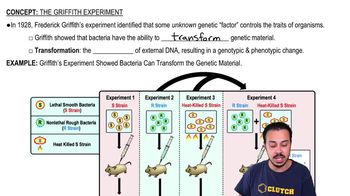
Griffith showed that a substance from dead virulent bacteria could transform non-virulent bacteria into virulent forms, suggesting a 'transforming principle'.
They identified DNA as the 'transforming principle' by showing that only DNA extracts could transform bacteria, ruling out proteins and RNA.
Using bacteriophages, they showed DNA, not protein, enters bacterial cells and carries genetic information.
Double helix structure with complementary base pairing (A-T, G-C), antiparallel strands, and right-handed helix.
Chargaff's rules state A=T and G=C, which Watson and Crick explained by complementary base pairing in the double helix.
Conservative, Semiconservative, and Dispersive replication models.
The semiconservative model, where each daughter DNA has one original and one new strand.
They used isotope labeling and density gradient centrifugation to show DNA replication is semiconservative.
Histones (H2A, H2B, H3, H4) that package DNA into nucleosomes.
Acetylation, methylation, phosphorylation mainly on histone tails, affecting chromatin structure and gene expression.
They alter chromatin condensation, making DNA more relaxed (active) or condensed (inactive).
The Y-shaped region where DNA is unwound and replicated during DNA synthesis.
Topoisomerase, Helicase, Single-Strand Binding Proteins (SSBPs), Primase, DNA Polymerase III, DNA Polymerase I, DNA Ligase.
Leading strand is synthesized continuously; lagging strand is synthesized discontinuously as Okazaki fragments.
Energy comes from hydrolysis of nucleoside triphosphates (dNTPs) during polymerization.
End replication problem causes loss of DNA at chromosome ends after each replication.
Telomeres are repetitive DNA sequences at chromosome ends that protect them from degradation.
By the enzyme telomerase, which contains an RNA template to add repeats to chromosome ends.
3' to 5' exonuclease proofreading activity corrects mismatches during replication.
Information flows from DNA to RNA to Protein.
Process of making an RNA copy from a DNA template.
Process of synthesizing proteins from mRNA by decoding its codons.
Set of rules where three-nucleotide codons specify amino acids; it is redundant, unambiguous, and nearly universal.
Process where different mRNAs are produced from the same pre-mRNA by including or excluding certain exons.
tRNA carries specific amino acids and matches its anticodon to mRNA codons during protein synthesis.
Cellular machinery composed of rRNA and proteins that synthesizes proteins by translating mRNA.
Initiation, elongation, and termination.
Heritable changes in gene expression without changes in DNA sequence, often via DNA methylation or histone modification.
Genotype is the genetic makeup; phenotype is the observable traits resulting from genotype and environment.
Proteins that regulate cell cycle progression by activating or inhibiting checkpoints.
They regulate cell cycle checkpoints and prevent uncontrolled cell division; mutations can lead to cancer.