Skip to main content
General Biology
My Course
Learn
Exam Prep
AI Tutor
Study Guides
Textbook Solutions
Flashcards
Explore
Try the app
My Course
Learn
Exam Prep
AI Tutor
Study Guides
Textbook Solutions
Flashcards
Explore
Try the app
Back
General Biology: Evolution and Diversity of Plants and Fungi
You can tap to flip the card.
Land plants origin
You can tap to flip the card.
👆
Land plants origin
Land plants evolved from freshwater algae and developed adaptations for life on land.
Track progress
Control buttons has been changed to "navigation" mode.
1/27
Recommended videos
Guided course
06:17
Land Plants - 4
3858
views
47
rank
Guided course
12:57
Land Plants - 2
4845
views
73
rank
2
comments
Guided course
03:36
Land Plants - 3
4186
views
20
rank
Terms in this set (27)
Hide definitions
Land plants origin
Land plants evolved from freshwater algae and developed adaptations for life on land.
Nonvascular plants
First land plants lacking tracheids, with a gametophyte-dominant life cycle and limited vertical growth.
Seedless vascular plants
Plants with vascular tissue and sporophyte-dominant life cycles; lignin supports vertical growth.
Seed plants groups
Monophyletic group divided into gymnosperms (naked seeds) and angiosperms (seeds enclosed in ovaries).
Cuticle function
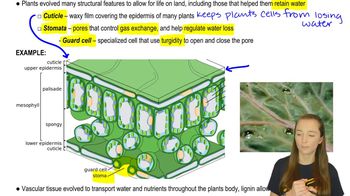
Waxy film covering plant epidermis that helps retain water.
Stomata and guard cells
Pores controlling gas exchange and water loss; guard cells regulate opening by changing turgidity.
Xylem and tracheids
Xylem transports water and minerals; tracheids are long cells with lignin-reinforced secondary walls.
Phloem function
Transports sugars, amino acids, and other nutrients throughout the plant.
Roots and leaves
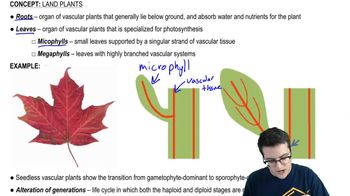
Roots absorb water and nutrients; leaves specialize in photosynthesis with microphylls or megaphylls.
Alternation of generations
Life cycle with multicellular haploid gametophyte and diploid sporophyte stages.
Gametophyte vs Sporophyte
Gametophyte is haploid and produces gametes; sporophyte is diploid and produces spores by meiosis.
Homospory vs Heterospory
Homospory produces one spore type; heterospory produces microspores (male) and megaspores (female).
Pollen and seeds
Pollen is male gametophyte with sporopollenin coat; seeds contain embryo and food supply with protective coat.
Bryophytes characteristics
Nonvascular plants like mosses with gametophyte-dominant life cycles and homosporous reproduction.
Gametangia types
Archegonia produce eggs; antheridia produce sperm; gametangia are contained in gametophores.
Sporophyte structures in bryophytes
Includes foot (nutrient absorption), seta (nutrient transport), and capsule (spore production).
Seedless vascular plants reproduction
Sporophyte-dominant, mostly homosporous, require water for sperm to reach egg.
Seed plant reproduction
Microscopic gametophytes develop within sporangia; heterosporous with pollen and ovules.
Gymnosperm seeds
Naked seeds not enclosed by ovary; sporangia usually in cones; can be monoecious or dioecious.
Angiosperm flower parts
Sepals protect buds; petals attract pollinators; stamens produce pollen; carpels contain ovules.
Double fertilization in angiosperms
Pollen tube releases two sperm: one fertilizes egg, other forms nutrient-rich endosperm.
Fungi characteristics
Heterotrophic eukaryotes, mostly haploid nuclei, main decomposers in ecosystems.
Fungal body structure
Hyphae are filamentous cells with chitin cell walls; mycelium is interwoven hyphae mass.
Fungal reproduction
Reproduce sexually and asexually via spores; sexual reproduction involves plasmogamy and karyogamy.
Mycorrhizae types
Ectomycorrhizae form hyphal sheaths outside roots; arbuscular fungi penetrate root cortical cells.
Basidiomycota reproduction
Dikaryotic hyphae form basidia where karyogamy occurs; fruiting body is basidiocarp.
Ascomycota reproduction
Dikaryotic hyphae form asci producing 8 haploid ascospores; asexual spores called conidia.
 BackBack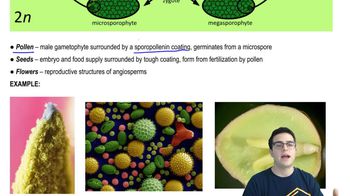
 06:17
06:17