 Back
BackGeneral Biology Exam 1 Key Concepts (Ch. 1-3)
 01:35
01:35
Terms in this set (29)
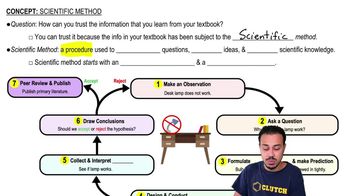
Includes observation, hypothesis formation, experimentation, data analysis, and conclusion.
Hypothesis: testable explanation; Prediction: expected outcome; Theory: well-supported broad explanation.
Experimental group: receives treatment; Control group: baseline for comparison, no treatment.
Independent variable: manipulated factor; Dependent variable: measured outcome.
Species change over time, passing traits to offspring with variations.
Individuals with advantageous traits survive and reproduce more, increasing trait frequency.
Evolution, structure and function, information flow, energy transformations, and systems biology.
Order, regulation, growth, energy processing, response to environment, reproduction, and evolution.
From atom < molecule < organelle < cell < tissue < organ < organism < population < community < ecosystem < biosphere.
Atoms consist of protons (+), neutrons (neutral), and electrons (-).
Atoms or molecules with a net electric charge due to loss or gain of electrons.
Elements required in small amounts; e.g., iodine prevents goiter.
Specific groups of atoms (e.g., hydroxyl) that determine molecule properties.
Reactants: starting substances; Products: substances formed.
Polarity, cohesion, adhesion, surface tension, high specific heat, evaporative cooling, and ice formation.
Measures acidity/basicity; buffers stabilize pH by absorbing or releasing H+ ions.
Covalent: shared electrons; Ionic: electron transfer; Hydrogen: weak attraction between polar molecules.
Can form four covalent bonds, enabling diverse complex molecules.
Monomers are single units; polymers are chains of monomers (e.g., glucose monomers form starch).
Dehydration: joins monomers by removing water; Hydrolysis: breaks polymers by adding water.
Saturated: no double bonds, solid at room temp; Unsaturated: one or more double bonds, liquid at room temp.
Hydrogenation adds H to unsaturated fats, creating trans fats linked to health risks.
Monosaccharides (glucose), disaccharides (sucrose), polysaccharides (starch, cellulose, glycogen).
DNA is double-stranded, stores genetic info; RNA is single-stranded, involved in protein synthesis.
A pairs with T (or U in RNA), and G pairs with C via hydrogen bonds.
Hydrophilic: water-attracting; Hydrophobic: water-repelling, important in macromolecule structure.
Primary (amino acid sequence), secondary (alpha helices, beta sheets), tertiary (3D folding), quaternary (multiple polypeptides).
Proteins that speed up chemical reactions by lowering activation energy.
Bacteria evolve resistance through natural selection acting on genetic variation.