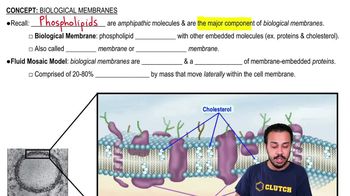
Cell membranes have a fluid mosaic model structure composed mainly of phospholipid bilayers with embedded proteins, allowing selective permeability and diverse functions.
Phospholipid molecule structure
Phospholipids have a hydrophilic head and two hydrophobic tails, enabling spontaneous bilayer formation in aqueous environments.
Spontaneous membrane formation
Phospholipids spontaneously form membranes because hydrophobic tails avoid water while hydrophilic heads interact with water, creating a bilayer.
Diffusion
Diffusion is the passive movement of molecules from an area of higher concentration to lower concentration.
Passive transport
Passive transport moves substances across membranes without energy input, following the concentration gradient.
Osmosis
Osmosis is the diffusion of water across a selectively permeable membrane from low to high solute concentration.
Hypertonic solution
A hypertonic solution has a higher solute concentration than the cell, causing water to leave the cell.
Hypotonic solution
A hypotonic solution has a lower solute concentration than the cell, causing water to enter the cell.
Isotonic solution
An isotonic solution has equal solute concentration to the cell, resulting in no net water movement.
Effect of hypertonic solution on animal and plant cells
Animal cells shrink; plant cells undergo plasmolysis as water leaves the cell.
Effect of hypotonic solution on animal and plant cells
Animal cells may burst; plant cells become turgid due to water intake.
Transport proteins in diffusion
Transport proteins facilitate diffusion by providing specific pathways for molecules to cross membranes.
Active transport vs facilitated diffusion
Active transport requires energy to move substances against their gradient; facilitated diffusion is passive and moves substances down their gradient.
Exocytosis
Exocytosis is the process of vesicles fusing with the plasma membrane to release contents outside the cell.
Endocytosis
Endocytosis is the process of cells engulfing substances by forming vesicles from the plasma membrane.
Phagocytosis
Phagocytosis is a type of endocytosis where large particles or cells are engulfed.
Receptor-mediated endocytosis
A selective form of endocytosis where receptors bind specific molecules before vesicle formation.
Kinetic energy
Kinetic energy is the energy of motion.
Potential energy
Potential energy is stored energy based on position or structure.
Chemical energy
Chemical energy is a form of potential energy stored in chemical bonds.
Heat
Heat is thermal energy transferred between objects due to temperature difference.
Endergonic reaction
An endergonic reaction absorbs energy and is non-spontaneous.
Exergonic reaction
An exergonic reaction releases energy and is spontaneous.
Cellular respiration
Cellular respiration is the process cells use to convert chemical energy from food into ATP.
Energy coupling
Energy coupling uses energy released from exergonic reactions to drive endergonic reactions.
ATP function
ATP functions as an energy shuttle by storing and transferring energy within cells.
How enzymes speed up reactions
Enzymes lower the activation energy required for reactions, speeding up the process.
Competitive inhibitor
A competitive inhibitor binds the enzyme's active site, blocking substrate binding.
Noncompetitive inhibitor
A noncompetitive inhibitor binds elsewhere on the enzyme, changing its shape and reducing activity.
 Back
Back
 02:21
02:21