 Back
BackGeneral Biology I - Cellular Respiration and Fermentation
 01:53
01:53
Terms in this set (22)
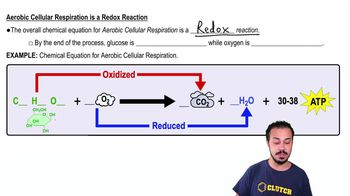
Glucose and oxygen are converted into carbon dioxide, water, and energy (ATP).
Equation: \(\mathrm{C_6H_{12}O_6 + 6O_2 \rightarrow 6CO_2 + 6H_2O + ATP}\)
Energy is required for cellular processes such as growth, repair, movement, and maintaining homeostasis.
A redox reaction involves the transfer of electrons where oxidation is loss of electrons and reduction is gain of electrons.
Dehydrogenase enzymes remove electrons (and hydrogen) from substrates, facilitating redox reactions.
NAD+ acts as an electron carrier, accepting electrons to become NADH during oxidation reactions.
The ETC transfers electrons through protein complexes, creating a proton gradient used to produce ATP.
Oxygen is the final electron acceptor in the ETC, combining with electrons and protons to form water.
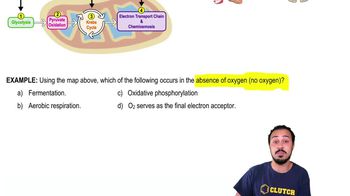
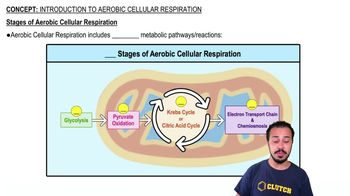
Glycolysis: cytoplasm; Citric acid cycle: mitochondrial matrix; Oxidative phosphorylation: inner mitochondrial membrane.
Produces 2 ATP by substrate-level phosphorylation and 2 NADH per glucose molecule.
Produces 2 ATP by substrate-level phosphorylation, plus NADH and FADH2 per glucose.
Produces about 26-28 ATP by chemiosmosis using the proton gradient.
Approximately 30-32 ATP molecules can be produced from one glucose molecule.
Both regenerate NAD+ from NADH to allow glycolysis to continue. Alcohol fermentation produces ethanol and CO2; lactic acid fermentation produces lactate.
All can be broken down into molecules entering cellular respiration; fats yield more ATP per gram due to more energy-rich bonds.
Fats have more C-H bonds which store more energy, resulting in higher ATP yield per gram.
Nutrients provide carbon skeletons and energy for building macromolecules like proteins, lipids, and nucleic acids.
Acetyl CoA is a molecule that delivers acetyl groups to the citric acid cycle for energy production.
ATP synthase is an enzyme that synthesizes ATP using the proton gradient during oxidative phosphorylation.
Chemiosmosis is the process of ATP generation using energy from a proton gradient across a membrane.
Glycolysis is the breakdown of glucose into pyruvate, producing ATP and NADH in the cytoplasm.
Pyruvate oxidation converts pyruvate into acetyl CoA, releasing CO2 and producing NADH in mitochondria.
Substrate-level phosphorylation is the direct synthesis of ATP by transferring a phosphate group to ADP from a substrate molecule.