 Back
BackGeneral Biology I - Photosynthesis and Plant Biology
 03:32
03:32
Terms in this set (31)
An organism that produces its own food from inorganic substances using light or chemical energy. Examples include plants and photoautotrophs.
An organism that obtains energy by consuming other organisms or organic matter.
An autotroph that uses light energy to synthesize organic compounds from carbon dioxide.
Organisms, usually autotrophs, that produce organic compounds from inorganic sources and serve as a food source for other organisms.
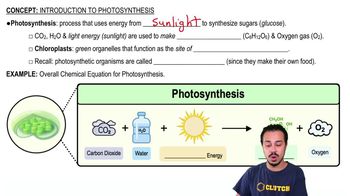
Organelles in plant cells containing thylakoids stacked into grana, surrounded by stroma; site of photosynthesis.
Most light energy is converted to chemical energy in the thylakoid membranes of chloroplasts.
Oxygen is produced during photosynthesis by splitting water molecules in the light reactions.
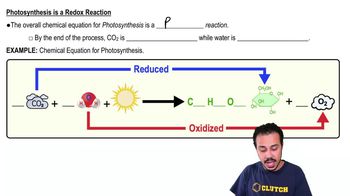
Photosynthesis involves oxidation of water and reduction of carbon dioxide through electron transfer reactions.
Reactants: light, water, NADP+, ADP; Products: oxygen, NADPH, ATP.
Reactants: CO2, ATP, NADPH; Products: G3P (sugar), ADP, NADP+.
Chlorophylls and carotenoids absorb light energy; chlorophyll a is the main pigment for photosynthesis.
Photosystems capture solar energy and use it to excite electrons for the electron transport chain.
Transfers electrons from water to NADP+, generating NADPH and creating a proton gradient for ATP synthesis.
Proton gradient across thylakoid membrane drives ATP synthase to produce ATP.
Process of generating ATP using light energy during the light reactions.
Calvin cycle depends on ATP and NADPH produced by light reactions to fix carbon dioxide into sugars.
Incorporation of CO2 into organic molecules during the Calvin cycle.
Plants that fix carbon using only the Calvin cycle; example: wheat.
Plants that fix carbon dioxide into a four-carbon compound before the Calvin cycle; example: corn.
Plants that fix carbon dioxide at night and use it during the day to minimize water loss; example: cacti.
Process where oxygen is fixed instead of carbon dioxide, reducing photosynthetic efficiency.
Leaf tissue where most photosynthesis occurs, containing many chloroplasts.
Small pores on leaf surfaces that allow gas exchange.
Fluid-filled space surrounding thylakoids in chloroplasts where the Calvin cycle occurs.
Membrane-bound sacs inside chloroplasts where light reactions take place.
A particle of light that carries energy used in photosynthesis.
Electron carrier that accepts electrons during light reactions to form NADPH.
Distance between peaks of light waves; determines light energy absorbed by pigments.
Range of all types of electromagnetic radiation, including visible light used in photosynthesis.
Warming of Earth’s surface caused by atmospheric gases trapping heat.
Long-term alteration of temperature and typical weather patterns, influenced by greenhouse gases.