 Back
BackGeneral Biology: Key Concepts in Fungi, Plants, and Ecology

 09:04
09:04
Terms in this set (31)
Opisthokonts are a clade that includes the common ancestor of fungi and animals.
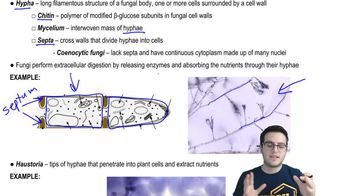
Fungi are eukaryotic, mostly multicellular organisms that absorb nutrients through their cell walls made of chitin.
Plasmogamy is the fusion of cytoplasm from two fungal cells; karyogamy is the fusion of their nuclei.
Chytrids, Mucoromycetes, Basidiomycetes, and Ascomycetes are major fungal groups, each with distinct characteristics and example organisms.
Fungi act as decomposers (saprotrophs), mutualists (mycorrhizae, lichens), and pathogens.
Embryophytes are land plants with adaptations for terrestrial life, including a multicellular embryo.
Life cycle with multicellular haploid gametophyte and multicellular diploid sporophyte stages.
Non-vascular land plants including mosses, liverworts, and hornworts; lack vascular tissue.
Vascular plants with xylem and phloem; include lycophytes, monilophytes (ferns), and seed plants.
Seed plants produce pollen (male microgametophyte), ovules (female megagametophyte), and seeds.
Seed plants with naked seeds; include conifers, cycads, gnetophytes, and Ginkgo.
Flowering plants with flowers and fruits; undergo double fertilization.
Includes sepals, petals, stamens (male), and carpels (female).
Adaptations of flowers to attract specific pollinators.
In angiosperms, one sperm fertilizes the egg, the other fuses with two nuclei to form endosperm.
Monocots have one cotyledon, parallel veins, and scattered vascular bundles; eudicots have two cotyledons, net veins, and ringed vascular bundles.
Regions of undifferentiated cells responsible for indeterminate growth.
Dermal (protection), ground (photosynthesis, storage), and vascular (transport).
Xylem transports water; phloem transports sugars.
Apoplast (cell walls), symplast (cytoplasm connected by plasmodesmata), and transmembrane pathways.
Active transport requires energy to move substances against gradients; passive transport does not.
Osmosis depends on water potential; hypertonic, hypotonic, and isotonic describe solute concentrations affecting water movement.
Flaccid: limp; turgid: swollen with water; plasmolysed: membrane pulled from cell wall.
Transpiration moves water through xylem; translocation moves sugars through phloem.
Cohesion-tension moves water up xylem; pressure-flow moves sugars in phloem.
Plant adaptations to dry environments, such as thick cuticles and reduced leaf area.
Humans' innate affinity for nature and living organisms.
Species facing an extremely high risk of extinction in the wild.
Regions with high species richness and endemism, threatened by human activity; term coined by Norman Myers.
A host organism plus all its associated microorganisms functioning as a unit.
Species like parasites and predators that have a disproportionate effect on ecosystem stability.