 Back
BackGeneral Biology: Key Concepts in Life and Scientific Inquiry
 09:26
09:26
Terms in this set (20)
The levels include biosphere, ecosystem, community, population, organism, organ system, organ, tissue, cell, organelle, molecule, and atom.
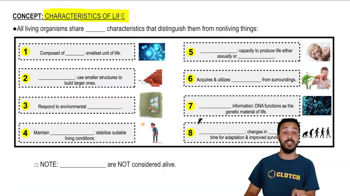
Order, reproduction, growth and development, response to the environment, energy processing, regulation, and evolutionary adaptation.
Observation, question, hypothesis, prediction, test of prediction, and results.
A testable and falsifiable explanation for an observation or question.
A hypothesis is a proposed explanation; a scientific theory is broad in scope and supported by a large body of evidence.
Predictions specify what results would support or contradict a hypothesis.
Testing predictions through experiments or observations determines if a hypothesis is supported or rejected.
It ensures validation, critique, and improvement of scientific knowledge.
All living organisms in a community plus the physical environment they interact with.
A population is a group of individuals of one species; a community includes all populations in an area.
A specialized structure within a cell that performs a specific function.
Organisms take in energy and use it to perform biological work.
Maintaining internal stability despite external changes (homeostasis).
Changes in populations over generations that enhance survival and reproduction.
Living things exhibit complex but ordered structures at all levels.
Through inherited genetic information directing cellular processes.
Organisms detect and respond to stimuli to survive.
An observation is a fact or occurrence; a hypothesis is an explanation for it.
To gather new data and generate questions and hypotheses.
Science aims to improve human life and inform policy through knowledge.