Land plants evolved from freshwater algae and developed adaptations for life on land, forming the subgroup embryophytes.
Nonvascular plants characteristics
Nonvascular plants lack tracheids, have a gametophyte-dominant life cycle, and many have internal water-conducting tissue but cannot support large vertical growth.
Seedless vascular plants life cycle
Seedless vascular plants have a sporophyte-dominant life cycle and possess vascular tissue with lignin, allowing vertical growth.
Seed plants groups
Seed plants are monophyletic and divided into gymnosperms with naked seeds and angiosperms with seeds enclosed in fruits.
Cuticle function in plants
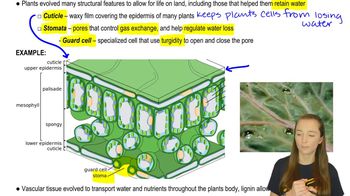
The cuticle is a waxy film covering the epidermis that helps plants retain water by reducing water loss.
Stomata and guard cells
Stomata are pores controlling gas exchange and water loss, regulated by guard cells that open and close the pore using turgidity.
Xylem structure and function
Xylem transports water and minerals; it includes tracheids with secondary cell walls containing lignin for rigidity.
Phloem function
Phloem transports sugars, amino acids, and other nutrients throughout the plant.
Roots and leaves in vascular plants
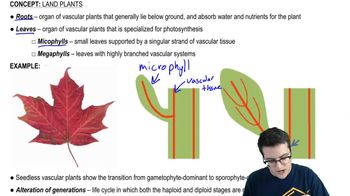
Roots absorb water and nutrients, while leaves are specialized for photosynthesis; leaves can be microphylls or megaphylls.
Alternation of generations
A life cycle with multicellular haploid gametophyte producing gametes and multicellular diploid sporophyte producing spores by meiosis.
Gametophyte vs. sporophyte
Gametophyte is haploid and produces gametes; sporophyte is diploid and produces spores.
Sporophylls and sporangia
Sporophylls are modified leaves bearing sporangia, which are structures where spores form.
Homospory vs. heterospory
Homospory produces one type of spore; heterospory produces microspores (male) and megaspores (female).
Pollen and seeds
Pollen is the male gametophyte with a protective sporopollenin coat; seeds contain an embryo and food supply with a tough coat.
Bryophytes characteristics
Bryophytes are nonvascular plants including mosses, liverworts, and hornworts, with gametophyte-dominant life cycles and homospory.
Gametangia types
Archegonia are female gametangia producing eggs; antheridia are male gametangia producing sperm.
Monoicious vs. dioicous plants
Monoicious plants bear sperm and egg on the same gametophyte; dioicous plants have separate male and female gametophytes.
Bryophyte sporophyte parts
Sporophyte includes foot (nutrient absorption), seta (nutrient transport), and capsule (spore production via meiosis).
Protonema in bryophytes
Protonema is a chain of cells growing from spores that develops into the mature gametophyte.
Seedless vascular plants and water dependence
Seedless vascular plants have sporophyte-dominant life cycles, require water for sperm to reach eggs, and include lycophytes and monilophytes.
Ferns and sori
Ferns produce sori, clusters of sporangia on leaf undersides; gametophytes contain antheridia, archegonia, and rhizoids.
 Back
Back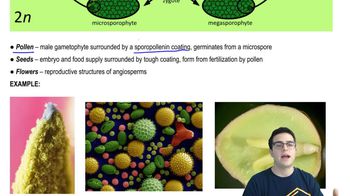
 06:17
06:17