 Back
BackGeneral Biology: Properties of Life, Viruses, and Evolution
 09:26
09:26
Terms in this set (20)
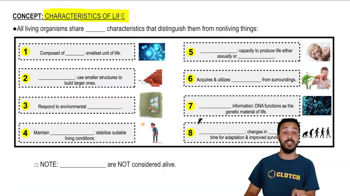
Order, Regulation, Growth and Development, Energy Processing, Response to Environment, Reproduction, and Evolutionary Adaptation.
Biological order refers to the highly organized structure of living organisms, from molecules to cells to organisms.
Homeostasis is the regulation of internal conditions to maintain a stable, constant environment within an organism.
Growth and development are controlled by inherited genetic information encoded in DNA.
Energy processing is the use of chemical energy to power an organism's activities and chemical reactions.
Organisms respond to environmental changes to survive, such as moving toward light or reacting to temperature changes.
Reproduction is the process by which organisms produce new individuals, passing genetic information to offspring.
Evolutionary adaptation is the process by which populations become better suited to their environment through natural selection.
Viruses are infectious agents made of genetic material (DNA or RNA) enclosed in a protein coat; they require a host cell to reproduce.
Because viruses lack cellular structure and cannot carry out metabolism or reproduce independently.
A virus consists of genetic material (DNA or RNA) surrounded by a protein coat called a capsid; some have an outer lipid envelope.
Viruses reproduce by infecting a host cell and hijacking its machinery to produce new virus particles.
Evolution explains the diversity of life and how species change over time through genetic variation and natural selection.
Natural selection is the process where individuals with advantageous traits survive and reproduce more successfully.
Genetic variation is the diversity in gene frequencies within a population, essential for evolution.
Mutations introduce new genetic variations by altering DNA sequences, which can be beneficial, neutral, or harmful.
An adaptation is a heritable trait that increases an organism's fitness in its environment.
The fossil record provides evidence of past life forms and evolutionary changes over time.
Homologous structures indicate common ancestry by showing similar anatomy despite different functions.
Prokaryotic cells lack a nucleus and membrane-bound organelles; eukaryotic cells have both.