 Back
BackGeneral Biology: The Chemical Basis of Life
 02:13
02:13
Terms in this set (29)
Matter is anything that occupies space and has mass.
Solid, liquid, and gas.
An element is a substance that cannot be broken down to other substances by ordinary chemical means.
Oxygen, carbon, hydrogen, and nitrogen.
A compound is a substance consisting of two or more different elements in a fixed ratio.
An atom is the smallest unit of matter that retains the properties of an element.
Protons (+), electrons (-), and neutrons (neutral).
The atomic number is the number of protons in the atomic nucleus.
Atomic mass is approximately the sum of protons and neutrons in the nucleus.
Isotopes are atoms of the same element with the same number of protons but different numbers of neutrons.
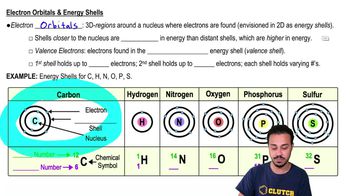
The number of electrons in the outermost shell, called the valence shell.
Carbon needs 4 electrons to fill its valence shell.
Attractions that hold atoms close together by sharing, donating, or receiving electrons to complete outer shells.
Covalent bonds, ionic bonds, and hydrogen bonds.
A bond where two atoms share a pair of electrons to complete their valence shells.
Electronegativity is the attraction an atom has for shared electrons in a covalent bond.
Nonpolar bonds share electrons equally; polar bonds share electrons unequally due to different electronegativities.
An attraction between two ions with opposite charges formed by donating or receiving electrons.
Atoms that have gained or lost electrons and thus have a charge.
A weak bond between molecules due to electrostatic attraction between a proton in one molecule and an electronegative atom in another.
Cohesion, adhesion, surface tension, temperature moderation, universal solvent, and acid-base properties.
The tendency of water molecules to stick together due to hydrogen bonding.
The tendency of water molecules to stick to other kinds of molecules.
Ice is less dense because stable hydrogen bonds hold molecules farther apart in a crystal lattice.
Solvent is the dissolving agent; solute is the substance dissolved.
An acid donates hydrogen ions (H+); a base reduces hydrogen ion concentration.
The acidity or basicity of a solution, ranging from 0 (acidic) to 14 (basic).
A substance that minimizes pH changes by accepting or donating H+ ions.
It accepts H+ when blood is too acidic and donates H+ when blood is too basic.