 Back
BackGeneral Biology: The Chemical Basis of Life
 02:13
02:13
Terms in this set (28)
An element is a substance that cannot be broken down into other substances by ordinary chemical means.
Protons (positive charge), neutrons (no charge), and electrons (negative charge).
The atomic number is the number of protons in an atom and equals the number of electrons in a neutral atom.
Number of neutrons = mass number minus atomic number.
Isotopes are atoms of the same element with the same atomic number but different mass numbers due to varying neutrons.
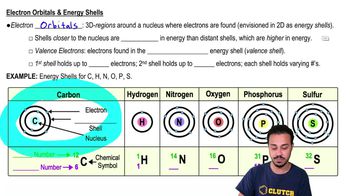
An electron shell is an energy level of electrons at a characteristic distance from the nucleus.
First shell: 2 electrons, second shell: 8 electrons, third shell: 18 electrons (but atoms are stable with 8).
The valence shell is the outermost electron shell of an atom, important for chemical bonding.
A molecule is a distinct substance formed when two or more atoms are covalently bonded.
A compound is a molecule containing two or more different elements bonded together.
The number of electrons needed to fill the valence shell determines how many bonds an atom can make.
An ionic bond forms when one atom donates electrons to another, creating charged ions.
Cations are positively charged ions; anions are negatively charged ions.
A covalent bond is the sharing of a pair of valence electrons by two atoms.
Electronegativity is the tendency of an atom to attract electrons in a bond.
A molecule is polar if atoms share electrons unevenly, creating partial positive and negative charges.
A hydrogen bond is a noncovalent attraction between a hydrogen atom and an electronegative atom.
Cohesion is the linking together of like molecules, often by hydrogen bonds, giving water surface tension.
Adhesion is the clinging of one substance to another, such as water to plant cell walls, via hydrogen bonds.
Thermal energy is total kinetic energy of molecules; temperature is the average kinetic energy.
Water requires a lot of energy to change temperature because heat disrupts hydrogen bonds before increasing molecular motion.
Evaporative cooling occurs when the hottest molecules evaporate first, cooling the remaining liquid.
Ice floats because hydrogen bonds stabilize in a lattice, making ice less dense than liquid water.
A solvent is the dissolving agent in a solution, such as water in an aqueous solution.
Hydrophilic substances have an affinity for water (polar or ionic); hydrophobic substances repel water (nonpolar).
An acid increases H+ concentration; a base reduces H+ concentration in water.
A buffer minimizes changes in H+ and OH- concentrations, stabilizing pH.
The pH scale is logarithmic; each unit change represents a 10-fold change in acidity or alkalinity.