 Back
BackMeiosis and Sexual Life
 01:43
01:43
Terms in this set (21)
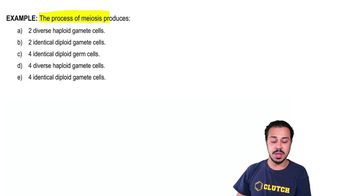
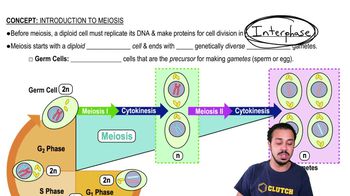
Meiosis is a type of cell division that reduces the chromosome number by half, producing four haploid cells, each genetically distinct from the parent cell.
To produce haploid gametes for sexual reproduction, ensuring genetic diversity.
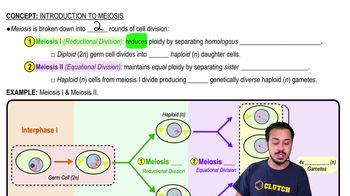
Two consecutive divisions: Meiosis I and Meiosis II.
Homologous chromosomes separate, reducing the chromosome number from diploid to haploid.
Sister chromatids separate, similar to mitosis, resulting in four haploid cells.
Pairs of chromosomes, one from each parent, that are similar in shape, size, and gene content.
The exchange of genetic material between homologous chromosomes during Prophase I, increasing genetic variation.
During Prophase I of meiosis.
The random orientation of homologous chromosome pairs during Metaphase I, leading to genetic variation.
Through crossing over, independent assortment, and random fertilization.
Haploid (n), half the original diploid number.
Mitosis produces two diploid identical cells; meiosis produces four haploid genetically diverse cells.
A group of four chromatids formed by paired homologous chromosomes during Prophase I.
A protein structure that forms between homologous chromosomes during Prophase I to facilitate crossing over.
Homologous chromosomes are pulled to opposite poles, sister chromatids remain attached.
Sister chromatids separate and move to opposite poles.
Diploid cells have two sets of chromosomes (2n); haploid cells have one set (n).
To maintain chromosome number across generations and generate genetic variation in offspring.
The random fusion of two haploid gametes, increasing genetic diversity.
Prophase I, Metaphase I, Anaphase I, Telophase I.
Prophase II, Metaphase II, Anaphase II, Telophase II.