Pearson+ LogoPearson+ Logo
Ch. 10 - Genetically Modified Organisms
Belk, Maier - Biology: Science for Life 6th Edition
Belk, Maier6th EditionBiology: Science for LifeISBN: 9780135214084Not the one you use?Change textbook
Chapter 10, Problem 10

Add labels to the figure that follows, which illustrates a transfer RNA molecule.
Diagram of a tRNA structure showing labeled components for educational context.

Verified step by step guidance
1
Identify the key structural components of the tRNA molecule. The tRNA has a cloverleaf structure with three main loops: the D-loop, the anticodon loop, and the TψC loop. Additionally, it has an acceptor stem at the top where the amino acid attaches.
Label the blue oval at the top of the first figure as the 'Amino Acid Attachment Site.' This is where the specific amino acid corresponding to the tRNA is covalently bonded.
Label the bottom loop in both figures as the 'Anticodon Loop.' This loop contains the anticodon sequence (e.g., CAG or AAA) that pairs with the complementary codon on the mRNA during translation.
Label the central region of the tRNA structure as the 'tRNA Backbone.' This includes the hydrogen-bonded stems and loops that maintain the molecule's shape.
In the second figure, label the orange sequence (UUU) as the 'mRNA Codon.' This is the sequence on the mRNA that pairs with the anticodon of the tRNA during protein synthesis.

Verified video answer for a similar problem:

This video solution was recommended by our tutors as helpful for the problem above.
Video duration:
1m
Was this helpful?

Key Concepts

Here are the essential concepts you must grasp in order to answer the question correctly.

Transfer RNA (tRNA)

Transfer RNA (tRNA) is a type of RNA molecule that plays a crucial role in protein synthesis. It serves as an adaptor that translates the genetic code from messenger RNA (mRNA) into amino acids, the building blocks of proteins. Each tRNA molecule carries a specific amino acid and has an anticodon region that pairs with the corresponding codon on the mRNA during translation.
Recommended video:
Guided course
07:20
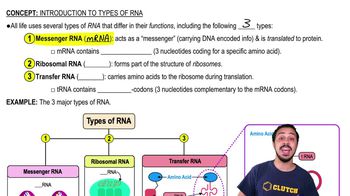
Introduction to Types of RNA

Amino Acid Attachment Site

The amino acid attachment site, often represented as the 'CCA' sequence at the 3' end of the tRNA, is where a specific amino acid is covalently bonded to the tRNA. This site is essential for the tRNA's function, as it ensures that the correct amino acid is delivered to the growing polypeptide chain during protein synthesis, based on the sequence of the mRNA.
Recommended video:

Anticodon

The anticodon is a sequence of three nucleotides on the tRNA that is complementary to a specific codon on the mRNA. This complementary pairing is critical for ensuring that the correct amino acid is incorporated into the protein being synthesized. The interaction between the anticodon and codon is a key step in the translation process, facilitating the accurate reading of the genetic code.