Pearson+ LogoPearson+ Logo
Ch. 14 - The Greatest Species on Earth?
Belk, Maier - Biology: Science for Life 6th Edition
Belk, Maier6th EditionBiology: Science for LifeISBN: 9780135214084Not the one you use?Change textbook
Chapter 14, Problem 4

Which of the following kingdoms or domains is a hodgepodge of different evolutionary lineages?
a. Bacteria
b. Protista
c. Archaea
d. Plantae
e. Animalia

Verified step by step guidance
1
Understand the question: The problem is asking which kingdom or domain is considered a 'hodgepodge,' meaning it contains a diverse mix of organisms that do not necessarily share a single evolutionary lineage.
Review the characteristics of each option: a. Bacteria are prokaryotic organisms with a single evolutionary lineage. b. Protista is a kingdom that includes a wide variety of eukaryotic organisms, such as algae, protozoa, and slime molds, which do not fit neatly into other kingdoms. c. Archaea are prokaryotic organisms distinct from bacteria and have their own evolutionary lineage. d. Plantae includes multicellular, photosynthetic organisms with a shared evolutionary lineage. e. Animalia includes multicellular, heterotrophic organisms with a shared evolutionary lineage.
Focus on the key term 'hodgepodge': This term suggests a group that is not monophyletic (does not share a single common ancestor) and includes organisms with diverse evolutionary origins.
Identify the correct answer: Based on the descriptions, the kingdom Protista is known for being a 'hodgepodge' because it includes organisms that are not closely related and do not fit into other kingdoms like Plantae, Animalia, or Fungi.
Conclude: The correct answer is b. Protista, as it is the kingdom that best matches the description of a 'hodgepodge of different evolutionary lineages.'

Verified video answer for a similar problem:

This video solution was recommended by our tutors as helpful for the problem above.
Video duration:
2m
Was this helpful?

Key Concepts

Here are the essential concepts you must grasp in order to answer the question correctly.

Kingdom Protista

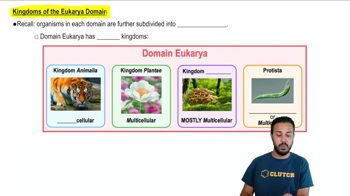
The kingdom Protista is known for its diverse range of organisms, which include unicellular and simple multicellular forms. It serves as a catch-all category for eukaryotic organisms that do not fit into the other kingdoms, such as plants, animals, or fungi. This diversity results from various evolutionary lineages, making Protista a 'hodgepodge' of different life forms.
Recommended video:
Guided course
02:28
Kingdoms of the Eukarya Domain

Evolutionary Lineages

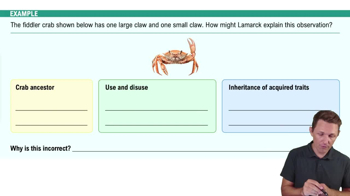
Evolutionary lineages refer to the sequences of species that have evolved from a common ancestor over time. Understanding these lineages helps in classifying organisms based on their evolutionary relationships. In the context of Protista, the presence of multiple lineages highlights the complexity and varied evolutionary paths that have led to the current diversity within this kingdom.
Recommended video:
02:45
History of Evolutionary Theory Example 1

Taxonomy

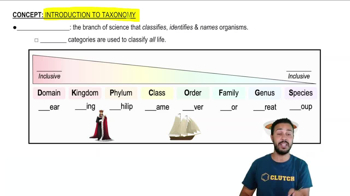
Taxonomy is the science of classifying organisms into hierarchical categories based on shared characteristics and evolutionary relationships. It helps in organizing biological diversity and understanding the relationships among different groups. The classification of Protista as a separate kingdom illustrates the challenges in taxonomy, especially when dealing with organisms that do not fit neatly into established categories.
Recommended video:
Guided course
02:23
Introduction to Taxonomy