Pearson+ LogoPearson+ Logo
Ch. 6 - Cancer
Belk, Maier - Biology: Science for Life 6th Edition
Belk, Maier6th EditionBiology: Science for LifeISBN: 9780135214084Not the one you use?Change textbook
Chapter 6, Problem 7

Sister chromatids ________.
a. Are two different chromosomes attached to each other.
b. Are exact copies of one chromosome that are attached to each other.
c. Arise from the centrioles.
d. Are broken down by mitosis.
e. Are chromosomes that carry different genes.

Verified step by step guidance
1
Understand the term 'sister chromatids': Sister chromatids are identical copies of a single chromosome that are formed during DNA replication. They are connected by a structure called the centromere.
Eliminate option (a): Sister chromatids are not two different chromosomes. They are identical copies of the same chromosome, so this option is incorrect.
Eliminate option (c): Sister chromatids do not arise from centrioles. Centrioles are involved in organizing the spindle fibers during cell division, not in the formation of chromatids.
Eliminate option (d): Sister chromatids are not broken down by mitosis. Instead, they are separated into individual chromosomes during mitosis, specifically during anaphase.
Eliminate option (e): Sister chromatids do not carry different genes. Since they are exact copies of the same chromosome, they carry identical genetic information. This leaves option (b) as the correct description.

Verified video answer for a similar problem:

This video solution was recommended by our tutors as helpful for the problem above.
Video duration:
52s
Was this helpful?

Key Concepts

Here are the essential concepts you must grasp in order to answer the question correctly.

Sister Chromatids

Sister chromatids are identical copies of a single chromosome that are formed during DNA replication. They remain attached at a region called the centromere until they are separated during cell division. This ensures that each daughter cell receives an exact copy of the genetic material.
Recommended video:
Guided course
03:56
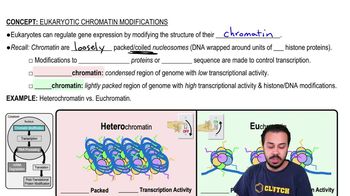
Eukaryotic Chromatin Modifications

Chromosome Structure

A chromosome is a long DNA molecule that contains genetic information. Each chromosome consists of two sister chromatids joined together, which are crucial for the accurate distribution of genetic material during cell division. Understanding chromosome structure is essential for grasping how genetic information is inherited.
Recommended video:
Guided course
08:09
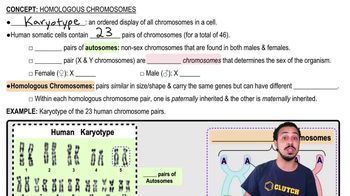
Homologous Chromosomes

Mitosis

Mitosis is the process of cell division that results in two genetically identical daughter cells. During mitosis, sister chromatids are separated and distributed to each daughter cell, ensuring that they each receive the same genetic information. This process is vital for growth, development, and tissue repair in multicellular organisms.
Recommended video:
Guided course
03:21
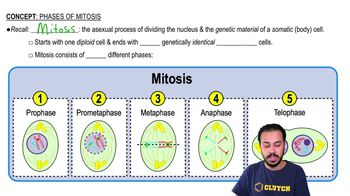
Phases of Mitosis