
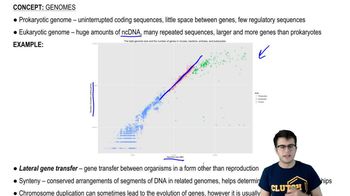
What is left for genetic researchers to do now that the Human Genome Project has determined nearly complete nucleotide sequences for all of the human chromosomes? Explain.
Verified step by step guidance
Verified video answer for a similar problem:
Key Concepts
Human Genome Project
Post-Genome Research
Ethical Considerations in Genetics
A biologist isolated a gene from a human cell, inserted it into a plasmid, and inserted the plasmid into a bacterium. The bacterium made a new protein, but it was nothing like the protein normally produced in a human cell. Why? (Explain your answer.)
a. The bacterium had undergone transformation.
b. The gene did not have sticky ends.
c. The human gene contained introns.
d. The gene was not synthesized from scratch.
Explain how you might engineer E. coli to produce human growth hormone (HGH) using the following: E. coli containing a plasmid, DNA carrying the gene for HGH, DNA ligase, a restriction enzyme, equipment for manipulating and growing bacteria, a method for extracting and purifying the hormone, and an appropriate DNA probe. (Assume that the human HGH gene lacks introns.)
The possibility of extensive genetic testing raises questions about how personal genetic information should be used. For example, should employers or potential employers have access to such information?
