Pearson+ LogoPearson+ Logo
Ch. 17 The Evolution of Plant and Fungal Diversity
Taylor - Campbell Biology: Concepts & Connections 10th Edition
Taylor, Simon, Dickey, Hogan10th EditionCampbell Biology: Concepts & ConnectionsISBN: 9780136538783Not the one you use?Change textbook
Chapter 17, Problem 4

Which of the following structures produce eggs and sperm? (Explain your answer.)
a. Fern sporophytes
b. Moss gametophytes
c. The anthers of a flower
d. Moss sporangia

Verified step by step guidance
1
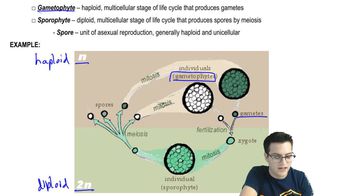
Understand the life cycle of plants, which alternates between two generations: the sporophyte (diploid) and the gametophyte (haploid). The gametophyte is responsible for producing gametes (eggs and sperm), while the sporophyte produces spores.
Analyze option a: Fern sporophytes. Sporophytes are diploid structures that produce spores through meiosis, not gametes (eggs and sperm). Therefore, this option is incorrect.
Analyze option b: Moss gametophytes. Gametophytes are haploid structures that produce gametes (eggs and sperm) through mitosis. In mosses, the gametophyte is the dominant generation, making this option correct.
Analyze option c: The anthers of a flower. Anthers are part of the sporophyte generation in flowering plants and produce pollen grains, which contain male gametophytes. These gametophytes eventually produce sperm, but the anthers themselves do not directly produce eggs or sperm. Therefore, this option is incorrect.
Analyze option d: Moss sporangia. Sporangia are part of the sporophyte generation and produce spores, not gametes. Thus, this option is incorrect.

Verified video answer for a similar problem:

This video solution was recommended by our tutors as helpful for the problem above.
Video duration:
2m
Was this helpful?

Key Concepts

Here are the essential concepts you must grasp in order to answer the question correctly.

Gametophyte and Sporophyte Generations

In the life cycle of plants, there are two distinct generations: the gametophyte, which is haploid and produces gametes (eggs and sperm), and the sporophyte, which is diploid and produces spores. In ferns and mosses, the gametophyte is the dominant stage in mosses, while ferns have a more prominent sporophyte stage.
Recommended video:
Guided course
04:43
Alteration of Generations

Anthers and Pollen Production

Anthers are part of the stamen in flowering plants and are responsible for producing pollen, which contains male gametes (sperm). This structure is crucial for sexual reproduction in angiosperms, as it facilitates the transfer of sperm to the ovule for fertilization.
Recommended video:
Guided course
04:36
Primary Production in Aquatic Ecosystems

Sporangia and Spore Production

Sporangia are structures found in both ferns and mosses that produce and release spores, which are asexual reproductive units. While sporangia are essential for the propagation of these plants, they do not produce eggs or sperm, which are formed in the gametophyte generation.
Recommended video:
Guided course
04:36
Primary Production in Aquatic Ecosystems