Pearson+ LogoPearson+ Logo
Ch. 36 Population Ecology
Taylor - Campbell Biology: Concepts & Connections 10th Edition
Taylor, Simon, Dickey, Hogan10th EditionCampbell Biology: Concepts & ConnectionsISBN: 9780136538783Not the one you use?Change textbook
Chapter 36, Problem 9

According to data on ecological footprints
a. The carrying capacity of the world is 10 billion
b. Earth's resources are sufficient to sustain future generations at current levels of consumption
c. The ecological footprint of individuals in the United States is more than twice the world average
d. Nations with the largest ecological footprints have the fastest population growth rates

Verified step by step guidance
1
Understand the concept of an ecological footprint: It measures the amount of biologically productive land and water area required to produce the resources consumed and to absorb the waste generated by an individual, population, or activity.
Analyze the options provided in the question. Each option makes a claim about ecological footprints and their implications. Carefully evaluate each statement based on known ecological and biological principles.
Option a: The carrying capacity of the world refers to the maximum population size that Earth can sustain indefinitely given the available resources. Research whether 10 billion is a scientifically supported estimate for Earth's carrying capacity.
Option b: Assess whether Earth's resources are sufficient to sustain future generations at current levels of consumption. Consider the concept of resource depletion and whether current consumption rates are sustainable.
Option c: Investigate whether the ecological footprint of individuals in the United States is more than twice the world average. Compare data on the average ecological footprint of U.S. citizens to the global average to verify this claim.

Verified video answer for a similar problem:

This video solution was recommended by our tutors as helpful for the problem above.
Video duration:
2m
Was this helpful?

Key Concepts

Here are the essential concepts you must grasp in order to answer the question correctly.

Carrying Capacity

Carrying capacity refers to the maximum number of individuals of a species that an environment can sustainably support without degrading the ecosystem. In the context of human populations, it considers factors such as resource availability, technology, and consumption patterns. Understanding carrying capacity is crucial for evaluating the sustainability of human activities and their impact on the planet.
Recommended video:
Guided course
06:24
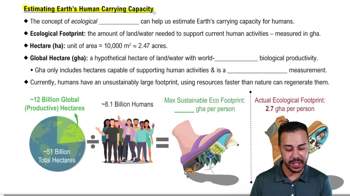
Estimating Earth’s Human Carrying Capacity

Ecological Footprint

The ecological footprint measures the environmental impact of an individual, community, or nation by calculating the amount of land and water area required to produce the resources consumed and absorb the waste generated. It provides insight into how human activities affect the planet's ecosystems. A larger ecological footprint indicates higher resource consumption and environmental strain, particularly in developed nations.
Recommended video:

Sustainability

Sustainability is the ability to meet present needs without compromising the ability of future generations to meet their own needs. It encompasses environmental, social, and economic dimensions, aiming for a balance that allows for resource use while preserving ecosystems. Understanding sustainability is essential for addressing issues like overpopulation, resource depletion, and climate change.
Recommended video:
Guided course
05:06
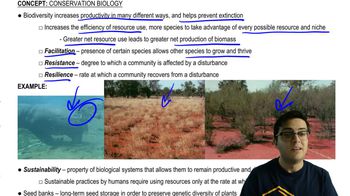
Biodiversity and Sustainability