
Pearson+ LogoPearson+ Logo
Ch. 8 The Cellular Basis of Reproduction and Inheritance
Taylor - Campbell Biology: Concepts & Connections 10th Edition
Taylor, Simon, Dickey, Hogan10th EditionCampbell Biology: Concepts & ConnectionsISBN: 9780136538783Not the one you use?Change textbook
Chapter 8, Problem 21

A mule is the offspring of a horse and a donkey. A donkey sperm contains 31 chromosomes and a horse egg cell contains 32 chromosomes, so the zygote contains a total of 63 chromosomes. The zygote develops normally. The combined set of chromosomes is not a problem in mitosis, and the mule combines some of the best characteristics of horses and donkeys. However, a mule is sterile; meiosis cannot occur normally in its testes (or ovaries). Explain why mitosis is normal in cells containing both horse and donkey chromosomes but the mixed set of chromosomes interferes with meiosis.

Verified step by step guidance
1
Understand the difference between mitosis and meiosis: Mitosis is a process of cell division that results in two genetically identical daughter cells from a single parent cell, maintaining the same chromosome number. Meiosis, on the other hand, is a type of cell division that reduces the chromosome number by half, resulting in four genetically diverse daughter cells, which are crucial for sexual reproduction.
Recognize the role of chromosome pairing in meiosis: During meiosis, homologous chromosomes (chromosomes that carry the same genes, one from each parent) pair up and exchange genetic material through a process called crossing over. This pairing is essential for the accurate segregation of chromosomes into gametes (sperm and egg cells).
Identify the chromosomal composition of a mule: A mule has a total of 63 chromosomes, with 31 chromosomes inherited from the donkey parent and 32 from the horse parent. This uneven number and the lack of completely homologous pairs prevent proper pairing and segregation during meiosis.
Explain why mitosis is not affected: In mitosis, the presence of non-homologous chromosomes does not prevent the chromosomes from being replicated and evenly divided between the two daughter cells. Each cell receives a complete set of 63 chromosomes, allowing normal cellular function and growth.
Discuss the impact on meiosis and resulting sterility: The lack of homologous chromosome pairs in mules leads to complications during meiosis, as the chromosomes cannot pair and segregate properly. This improper segregation during meiosis leads to the formation of gametes with abnormal chromosome numbers, resulting in sterility.

Verified video answer for a similar problem:

This video solution was recommended by our tutors as helpful for the problem above.
Video duration:
2m
Was this helpful?

Key Concepts

Here are the essential concepts you must grasp in order to answer the question correctly.

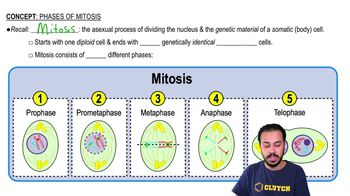
Mitosis

Mitosis is the process of cell division that results in two genetically identical daughter cells, each with the same number of chromosomes as the original cell. It involves a series of stages, including prophase, metaphase, anaphase, and telophase, where chromosomes are duplicated and evenly distributed. In the case of a mule, the presence of both horse and donkey chromosomes does not hinder mitosis because the chromosomes can align and separate properly during cell division.
Recommended video:
Guided course
03:21
Phases of Mitosis

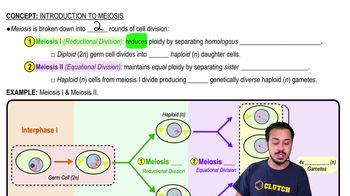
Meiosis

Meiosis is a specialized form of cell division that reduces the chromosome number by half, producing gametes (sperm and eggs) with unique genetic combinations. It involves two rounds of division and requires homologous chromosomes to pair and exchange genetic material. In mules, the mixed set of chromosomes from horses and donkeys cannot pair correctly during meiosis, leading to improper segregation and resulting in sterility.
Recommended video:
Guided course
04:49
Meiosis I & Meiosis II

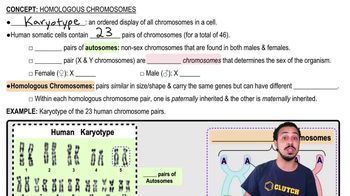
Chromosome Compatibility

Chromosome compatibility refers to the ability of chromosomes from different species to pair and segregate properly during cell division. In hybrids like mules, the differing chromosome numbers and structures from horses and donkeys create challenges during meiosis, as homologous chromosomes must match up to ensure accurate division. This incompatibility is why mules can undergo mitosis normally but are sterile due to failed meiosis.
Recommended video:
Guided course
08:09
Homologous Chromosomes
Related Practice
Textbook Question

Suppose you read in the newspaper that a genetic engineering laboratory has developed a procedure for fusing two gametes from the same person (two eggs or two sperm) to form a zygote. The article mentions that an early step in the procedure prevents crossing over from occurring during the formation of the gametes in the donor's body. The researchers are in the process of determining the genetic makeup of one of their new zygotes. Which of the following predictions do you think they would make? Justify your choice, and explain why you rejected each of the other choices.

a. The zygote would have 46 chromosomes, all of which came from the gamete donor (its one parent), so the zygote would be genetically identical to the gamete donor.

b. The zygote could be genetically identical to the gamete donor, but it is much more likely that it would have an unpredictable mixture of chromosomes from the gamete donor's parents.

c. The zygote would not be genetically identical to the gamete donor, but it would be genetically identical to one of the donor's parents.

d. The zygote would not be genetically identical to the gamete donor, but it would be genetically identical to one of the donor's grandparents.

1053
views
Textbook Question

Bacteria are able to divide on a faster schedule than eukaryotic cells. Some bacteria can divide every 20 minutes, while the minimum time required by eukaryotic cells in a rapidly developing embryo is about once per hour, and most cells divide much less often than that. State at least two testable hypotheses explaining why bacteria can divide at a faster rate than eukaryotic cells.

2491
views
Textbook Question

Red blood cells, which carry oxygen to body tissues, live for only about 120 days. Replacement cells are produced by cell division in bone marrow.

How many cell divisions must occur each second in your bone marrow just to replace red blood cells? Here is some information to use in calculating your answer: There are about 5 million red blood cells per cubic millimeter (mm³) of blood. An average adult has about 5 L (5,000 cm³) of blood. (Hint: What is the total number of red blood cells in the body?

What fraction of them must be replaced each day if all are replaced in 120 days?

2299
views
Textbook Question

What you think of as 'a banana' is a Cavendish, one variety of the species Musa acuminate. It is a triploid organism (3n) with three sets of chromosomes in every somatic cell. The Cavendish cannot be naturally bred; it can only be reproduced by cloning. Explain how its triploid state accounts for its inability to form normal gametes. Discuss how the lack of sexual reproduction might make the species particularly vulnerable to a new pest.

1590
views