Pearson+ LogoPearson+ Logo
Ch. 5 The Working Cell
Taylor - Campbell Biology: Concepts & Connections 10th Edition
Taylor, Simon, Dickey, Hogan10th EditionCampbell Biology: Concepts & ConnectionsISBN: 9780136538783Not the one you use?Change textbook
Chapter 5, Problem 2

Label the parts of the following diagram illustrating the catalytic cycle of an enzyme.
Diagram of an enzyme's catalytic cycle with labeled parts a, b, c, d, e, and f.

Verified step by step guidance
1
Step 1: Identify the enzyme structure in the diagram. The purple structure labeled 'a' represents the enzyme itself, which is a protein that catalyzes biochemical reactions.
Step 2: Label the active site of the enzyme. The region labeled 'b' is the active site, where the substrate molecules bind specifically to the enzyme.
Step 3: Recognize the substrate molecules. The hexagonal shapes labeled 'f' represent the substrates, which are the reactants that the enzyme acts upon.
Step 4: Label the enzyme-substrate complex. The structure labeled 'c' shows the enzyme bound to the substrates, forming the enzyme-substrate complex during the reaction.
Step 5: Label the product release. The structure labeled 'e' represents the enzyme releasing the products after the reaction is complete, and the enzyme is ready to catalyze another reaction.

Verified video answer for a similar problem:

This video solution was recommended by our tutors as helpful for the problem above.
Video duration:
1m
Was this helpful?

Key Concepts

Here are the essential concepts you must grasp in order to answer the question correctly.

Enzyme Structure

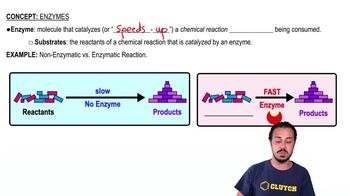
Enzymes are biological catalysts that speed up chemical reactions in the body. They have a specific three-dimensional structure that includes an active site, where substrates bind. The shape and chemical environment of the active site are crucial for the enzyme's ability to catalyze reactions effectively.
Recommended video:

Catalytic Cycle

The catalytic cycle of an enzyme describes the series of steps that occur during the conversion of substrates into products. This cycle typically includes substrate binding, the formation of an enzyme-substrate complex, the conversion of substrates into products, and the release of products, allowing the enzyme to return to its original state and catalyze another reaction.
Recommended video:

Substrate Specificity

Substrate specificity refers to the ability of an enzyme to selectively bind to a particular substrate or group of substrates. This specificity is determined by the shape and chemical properties of the enzyme's active site, which only fits certain substrates, ensuring that enzymes catalyze specific reactions efficiently without interference from other molecules.
Recommended video:
Guided course
10:55
Receptor Specificity