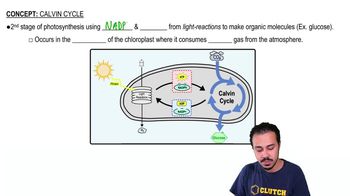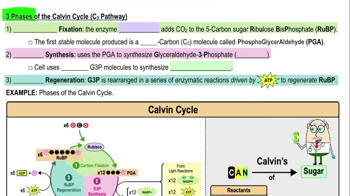
Describe the three phases of the Calvin cycle and how the products of the light-capturing reactions participate in this process.
Ch. 10 - Photosynthesis
Chapter 10, Problem 8
Which of the following correctly identify a role of the ATP produced in the light-capturing reactions? Select True or False for each statement.
T/F It is used by rubisco to fix CO2 to RuBP.
T/F It serves the same role as ATP produced by mitochondria.
T/F It is used to regenerate RuBP from G3P molecules.
T/F It is used to produce G3P molecules
Verified step by step guidance1
Understand the role of ATP in the light-capturing reactions of photosynthesis. ATP is produced during the light-dependent reactions and is used in the Calvin cycle, which is part of the light-independent reactions.
Consider the role of rubisco in the Calvin cycle. Rubisco is an enzyme that catalyzes the fixation of CO2 to RuBP (ribulose bisphosphate). ATP is not directly used by rubisco for this fixation process.
Compare the role of ATP produced in chloroplasts during photosynthesis with ATP produced in mitochondria during cellular respiration. While both types of ATP provide energy for cellular processes, they are used in different pathways and contexts.
Examine the regeneration of RuBP from G3P (glyceraldehyde-3-phosphate) molecules. ATP is indeed used in the Calvin cycle to regenerate RuBP from G3P, allowing the cycle to continue.
Analyze the production of G3P molecules in the Calvin cycle. ATP is used in the conversion of 3-phosphoglycerate to G3P, which is a crucial step in the cycle.

Verified video answer for a similar problem:
This video solution was recommended by our tutors as helpful for the problem above.
Video duration:
4mWas this helpful?
Key Concepts
Here are the essential concepts you must grasp in order to answer the question correctly.
ATP in Photosynthesis
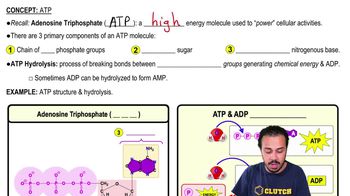
ATP, or adenosine triphosphate, is a crucial energy carrier in cells. In photosynthesis, ATP is produced during the light-dependent reactions and is used in the Calvin cycle to drive the synthesis of glucose from carbon dioxide and water. It provides the energy needed for various enzymatic reactions, including the regeneration of RuBP and the conversion of 3-phosphoglycerate to G3P.
Recommended video:
Calvin Cycle
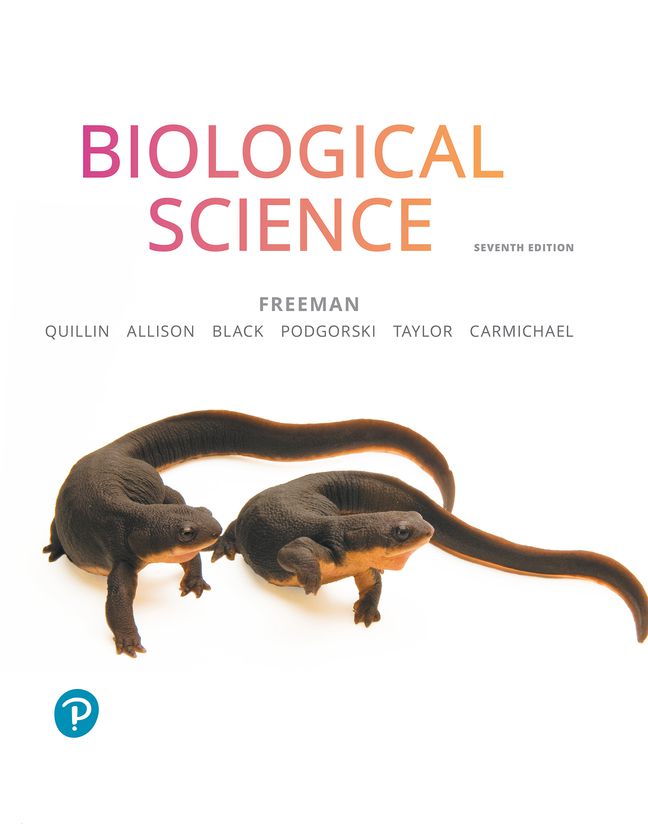
The Calvin cycle, also known as the light-independent reactions, occurs in the stroma of chloroplasts. It uses ATP and NADPH produced in the light-dependent reactions to convert CO2 into glucose. Key steps include carbon fixation by rubisco, reduction of 3-phosphoglycerate to G3P, and regeneration of RuBP, which allows the cycle to continue. ATP is essential for the regeneration of RuBP and the production of G3P.
Recommended video:
Guided course
Calvin Cycle
Role of Rubisco
Rubisco is an enzyme that catalyzes the first major step of carbon fixation in the Calvin cycle. It facilitates the attachment of CO2 to RuBP, forming 3-phosphoglycerate. While ATP is not directly used by rubisco, it is crucial for subsequent steps in the cycle, such as the conversion of 3-phosphoglycerate to G3P and the regeneration of RuBP, ensuring the cycle's continuity and efficiency.
Recommended video:
Guided course
3 Phases of the Calvin Cycle (C3 Pathway)
Related Practice
Textbook Question
560
views
Textbook Question
Describe the three phases of the Calvin cycle and how the products of the light-capturing reactions participate in this process.
1600
views
Textbook Question
Apply what you know of the relationship between the light-capturing reactions and the Calvin cycle to calculate the number of photons used to produce a new G3P and regenerate RuBP. (Assume 1 ATP is produced for each pair of electrons used to form NADPH.)
711
views
Textbook Question
Predict how the following conditions would affect the production of O2, ATP, and NADPH and state whether noncyclic or cyclic electron flow would occur in each: (1) Only blue photons hit a chloroplast
1136
views
Textbook Question
Predict how the following conditions would affect the production of O2, ATP, and NADPH and state whether noncyclic or cyclic electron flow would occur in each:
(1) Only blue photons hit a chloroplast
761
views
Textbook Question
Predict how the following conditions would affect the production of O2, ATP, and NADPH and state whether noncyclic or cyclic electron flow would occur in each:
(2) blue and red photons hit a chloroplast, but no NADP+ is available
1078
views