What is the significance of the observation that many signal transduction pathways create a network, where they intersect or overlap?
Ch. 11 - Cell-Cell Interactions
Chapter 11, Problem 9b
Steroid hormones, like most lipid-soluble signaling molecules, are processed directly. How does the absence of a signal transduction cascade in the processing of steroid hormones affect (b) signal regulation?
Verified step by step guidance1
Understand that steroid hormones are lipid-soluble, allowing them to pass through cell membranes easily and bind directly to intracellular receptors.
Recognize that the absence of a signal transduction cascade means that steroid hormones do not require a series of intermediary steps to relay their signal inside the cell.
Consider how direct binding to receptors affects signal regulation: the response is typically more straightforward and less modulated by other cellular components compared to pathways involving multiple steps.
Reflect on the implications of this direct action: the signal is less subject to amplification or attenuation, which can occur in multi-step cascades, leading to a more consistent and sustained response.
Conclude that while the direct pathway allows for rapid and specific responses, it may limit the cell's ability to finely tune the signal compared to more complex pathways with multiple regulatory points.

Verified video answer for a similar problem:
This video solution was recommended by our tutors as helpful for the problem above.
Video duration:
3mWas this helpful?
Key Concepts
Here are the essential concepts you must grasp in order to answer the question correctly.
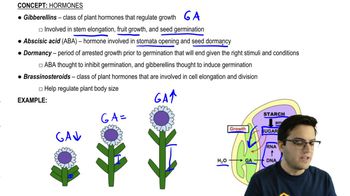
Steroid Hormones
Steroid hormones are lipid-soluble molecules derived from cholesterol, which can easily pass through cell membranes. Unlike peptide hormones, they do not require surface receptors and can directly interact with intracellular receptors, influencing gene expression and cellular function. This direct interaction allows for rapid and specific responses within target cells.
Recommended video:
Guided course
Plant Hormones and Senescence
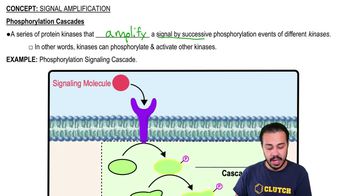
Signal Transduction Cascade
A signal transduction cascade is a series of molecular events initiated by the binding of a signaling molecule to a receptor, often involving multiple steps and amplification of the signal. This process typically involves secondary messengers and protein modifications, allowing for complex regulation and integration of signals, which can modulate cellular responses in a controlled manner.
Recommended video:
Guided course
Phosphorylation Cascades
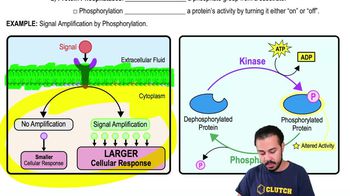
Signal Regulation
Signal regulation refers to the mechanisms that control the intensity, duration, and specificity of a cellular response to a signaling molecule. In the absence of a signal transduction cascade, as seen with steroid hormones, regulation is primarily achieved through receptor availability, hormone concentration, and direct gene expression changes, leading to a more straightforward but less modulated response compared to cascades.
Recommended video:
Guided course
Signal Amplification
Related Practice
Textbook Question
966
views
Textbook Question
Steroid hormones, like most lipid-soluble signaling molecules, are processed directly. How does the absence of a signal transduction cascade in the processing of steroid hormones affect (b) signal regulation?
1047
views
Textbook Question
Steroid hormones, like most lipid-soluble signaling molecules, are processed directly. How does the absence of a signal transduction cascade in the processing of steroid hormones affect (a) signal amplification?
1064
views
Textbook Question
Steroid hormones, like most lipid-soluble signaling molecules, are processed directly. How does the absence of a signal transduction cascade in the processing of steroid hormones affect (c) the cellular response that is possible?
861
views
Textbook Question
Suppose you have an antibody that binds to the receptor tyrosine kinase illustrated in Figure 11.16. When you add this antibody to the cell, you find that it activates the cell response, even when no signaling molecule is present. Explain this result.
775
views