Pearson+ LogoPearson+ Logo
Ch. 18 - Control of Gene Expression in Bacteria
Freeman - Biological Science 7th Edition
Freeman7th EditionBiological ScienceISBN: 9783584863285Not the one you use?Change textbook
Chapter 18, Problem 5

Evaluate these statements about regulation of the lac operon. Select True or False for each statement.T/FThe lac operon is transcribed at the highest rate when extracellular glucose and lactose are abundant.T/FThe repressor protein is bound to DNA of the operator when lactose is present.T/FA mutation in the operator is likely to prevent transcription of the lac operon under any condition.T/FA mutation that alters the catabolite activator protein is predicted to alter the regulation of many different operons.

Verified step by step guidance
1
Identify the role of glucose and lactose in the regulation of the lac operon. Recall that the presence of glucose inhibits the lac operon, while lactose is required to deactivate the repressor and allow transcription.
Understand the function of the repressor protein in the lac operon. The repressor binds to the operator to block transcription, but it is inactivated when lactose binds to it, allowing transcription to proceed.
Consider the impact of a mutation in the operator region of the lac operon. If the mutation prevents the repressor from binding, it could lead to continuous transcription, regardless of lactose presence.
Examine the role of the catabolite activator protein (CAP) in the regulation of the lac operon and other operons. CAP assists in the transcription of operons when glucose levels are low, enhancing the effect of other inducers like lactose.
Evaluate how a mutation in the CAP could affect its ability to bind to DNA or interact with other molecules, potentially altering the regulation of not only the lac operon but other operons regulated by CAP.

Verified video answer for a similar problem:

This video solution was recommended by our tutors as helpful for the problem above.
Video duration:
2m
Was this helpful?

Key Concepts

Here are the essential concepts you must grasp in order to answer the question correctly.

Lac Operon Structure and Function

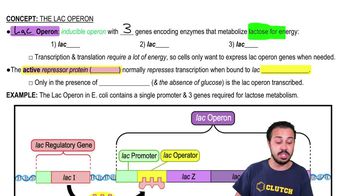
The lac operon is a set of genes in E. coli that are involved in the metabolism of lactose. It consists of three structural genes (lacZ, lacY, and lacA) and regulatory elements, including a promoter and an operator. The operon is regulated by the presence of lactose and glucose, allowing the bacteria to efficiently utilize available sugars.
Recommended video:
Guided course
07:06
The Lac Operon

Repressor Protein and Induction

The repressor protein binds to the operator region of the lac operon, preventing transcription when lactose is absent. When lactose is present, it binds to the repressor, causing a conformational change that releases the repressor from the operator, thus allowing transcription to occur. This mechanism is an example of negative regulation.
Recommended video:

Catabolite Activator Protein (CAP) and Positive Regulation

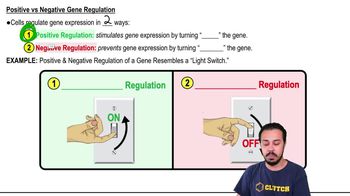
Catabolite activator protein (CAP) is involved in the positive regulation of the lac operon. When glucose levels are low, CAP binds to cAMP, which then binds to the CAP site near the lac promoter, enhancing RNA polymerase binding and increasing transcription. Mutations in CAP can disrupt this regulatory mechanism, affecting the expression of multiple operons.
Recommended video:
Guided course
02:17
Positive vs Negative Gene Regulation