
Pearson+ LogoPearson+ Logo
Ch. 18 - Control of Gene Expression in Bacteria
Freeman - Biological Science 7th Edition
Freeman7th EditionBiological ScienceISBN: 9783584863285Not the one you use?Change textbook
Chapter 18, Problem 2

In the lac operon, the repressor inhibits transcription whena. the repressor is bound to the inducer.b. the repressor is not bound to the inducer.c. the repressor is bound to glucose.d. the repressor is not bound to the operator.

Verified step by step guidance
1
Understand the function of the lac operon: The lac operon is a set of genes in bacteria that are involved in the metabolism of lactose. It is regulated by several components including the repressor protein, which plays a crucial role in controlling the transcription of the operon.
Identify the role of the repressor: The repressor protein can bind to the operator region of the lac operon, thereby blocking RNA polymerase from transcribing the downstream genes necessary for lactose metabolism.
Consider the effect of the inducer on the repressor: The inducer (allolactose, a derivative of lactose) binds to the repressor. When the inducer is bound to the repressor, it causes a conformational change in the repressor.
Analyze the conformational change: This change in shape of the repressor reduces its affinity for the operator region, preventing it from binding effectively.
Conclude the correct condition for inhibition: Since the binding of the inducer to the repressor prevents the repressor from binding to the operator, transcription is inhibited when the repressor is not bound to the inducer.

Verified video answer for a similar problem:

This video solution was recommended by our tutors as helpful for the problem above.
Video duration:
1m
Was this helpful?

Key Concepts

Here are the essential concepts you must grasp in order to answer the question correctly.

Lac Operon Structure

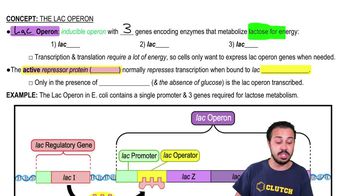
The lac operon is a set of genes in E. coli that are involved in the metabolism of lactose. It consists of three structural genes (lacZ, lacY, and lacA) and regulatory elements, including a promoter and an operator. The operon is controlled by a repressor protein that binds to the operator region, preventing transcription when lactose is absent.
Recommended video:
Guided course
07:06
The Lac Operon

Repressor Protein Function

The repressor protein is a key regulatory element in the lac operon. It binds to the operator region of the operon, blocking RNA polymerase from transcribing the downstream genes. When lactose is present, it binds to the repressor, causing a conformational change that prevents the repressor from binding to the operator, thus allowing transcription to occur.
Recommended video:
Guided course
03:54
Membrane Protein Functions

Inducer Molecules

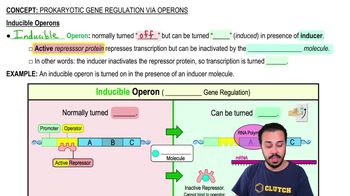
Inducers are molecules that trigger the expression of genes by inactivating repressors. In the case of the lac operon, allolactose, a derivative of lactose, acts as the inducer. When allolactose binds to the repressor, it alters the repressor's shape, preventing it from binding to the operator, which leads to the transcription of the lac genes necessary for lactose metabolism.
Recommended video:
Guided course
04:25
Inducible Operons