
Pearson+ LogoPearson+ Logo
Ch. 18 - Control of Gene Expression in Bacteria
Freeman - Biological Science 7th Edition
Freeman7th EditionBiological ScienceISBN: 9783584863285Not the one you use?Change textbook
Chapter 18, Problem 12

The light-producing genes of V. fischeri are organized in an operon that is under positive control by an activator protein called LuxR. Would you expect the genes of this operon to be transcribed when LuxR is bound or not bound to a DNA regulatory sequence? Explain.

Verified step by step guidance
1
Understand the role of LuxR: LuxR is an activator protein, which means it facilitates the transcription of genes by helping RNA polymerase initiate transcription when it is bound to a DNA regulatory sequence.
Identify the control mechanism: Since the operon is under positive control by LuxR, the presence of LuxR bound to the DNA enhances the transcription of the genes within the operon.
Consider the effect of LuxR binding: When LuxR is bound to the DNA regulatory sequence, it activates the transcription of the light-producing genes in the operon of V. fischeri.
Analyze the scenario when LuxR is not bound: If LuxR is not bound to the DNA regulatory sequence, the operon will not be actively transcribed because the positive control by LuxR is absent, leading to low or no transcription of the light-producing genes.
Conclude the transcription status: Based on the role of LuxR as an activator in positive control, you would expect the genes of this operon to be transcribed when LuxR is bound to a DNA regulatory sequence.

Verified video answer for a similar problem:

This video solution was recommended by our tutors as helpful for the problem above.
Video duration:
45s
Was this helpful?

Key Concepts

Here are the essential concepts you must grasp in order to answer the question correctly.

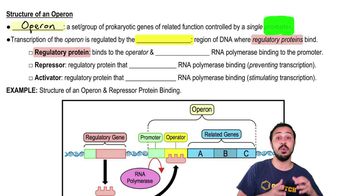
Operon Structure

An operon is a cluster of genes under the control of a single promoter, allowing for coordinated expression. In prokaryotes, operons enable the regulation of genes that encode proteins with related functions, facilitating efficient resource use. The organization of genes in an operon allows for simultaneous transcription and translation, which is crucial for rapid responses to environmental changes.
Recommended video:
Guided course
04:23
Structure of an Operon

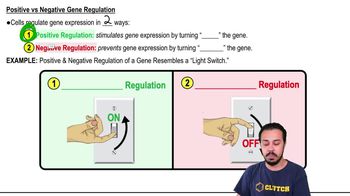
Positive Control in Gene Regulation

Positive control refers to the mechanism by which an activator protein enhances the transcription of a gene or operon. In the case of V. fischeri, the LuxR protein binds to a specific DNA sequence, promoting the recruitment of RNA polymerase to the promoter region. This interaction increases the likelihood of transcription occurring, thereby facilitating the expression of light-producing genes when conditions are favorable.
Recommended video:
Guided course
02:17
Positive vs Negative Gene Regulation

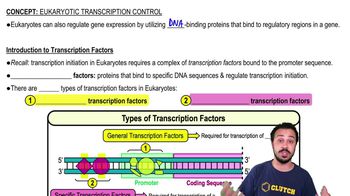
Transcription Factors

Transcription factors are proteins that bind to specific DNA sequences to regulate gene expression. They can act as activators or repressors, influencing the transcription of target genes. In the context of the LuxR protein, its binding to the DNA regulatory sequence is essential for initiating transcription of the operon, highlighting the critical role of transcription factors in gene regulation.
Recommended video:
Guided course
03:32
Introduction to Transcription Factors
Related Practice
Textbook Question
In a mutant that lacks adenylyl cyclase, the enzyme that synthesizes cAMP, predict which of the following conditions of extracellular lactose and glucose would cause regulation of the lac operon to differ from that of wild-type cells.a. no lactose, no glucoseb. no lactose, abundant glucosec. abundant lactose, no glucosed. abundant lactose, abundant glucose
822
views
Textbook Question
X-gal is a colorless, lactose-like molecule that can be split into two fragments by ββ-galactosidase. One of these product molecules creates a blue color. The photograph here shows E. coli colonies growing in a medium that contains X-gal. Find three colonies whose cells have functioning copies of ββ-galactosidase. Find three colonies whose cells might have mutations in the lacZ or the lacY genes. Suppose you analyze the protein-coding sequence of the lacZ and lacY genes of cells from the three mutant colonies and find that these sequences are wild type (normal). What other region of the lac operon might be altered to account for the mutant phenotype of these colonies?
1298
views
Textbook Question

The Hawaiian bobtail squid (Euprymna scolopes) is able to glow from luminescent Vibrio fischeri bacteria held in its light organs. As it swims at night near the ocean surface, it adjusts the amount of light visible to predators below to match the light from the stars and moon. Predators have difficulty seeing the illuminated squid against the night sky.

The bacteria glow in response to a molecule that regulates expression of genes involved in light-producing chemical reactions. The regulator controls production of the genes' mRNA. Therefore, the light-producing genes are under

a. Transcriptional control.

b. Translational control.

c. Post-translational control.

d. Negative control.

508
views
Textbook Question
The diagram shown here is a model of the gene regulatory circuit for light production by V. fischeri cells. The lux operon contains genes for luminescence (luxCDABE) and a gene, luxI, that encodes an enzyme that catalyzes the production of an inducer. This inducer easily moves back and forth across the plasma membrane and acts as a signaling molecule. The lux operon is never completely turned off. The luxR gene codes for the activator LuxR. The inducer can bind to LuxR, and when it does, the LuxR–inducer complex can bind to a regulatory site to activate transcription of the lux operon and inhibit transcription of luxR. Explain how this gene regulatory circuit accounts for bacteria emitting light only when they reach a high cell density.
816
views
Textbook Question
LuxR is allosterically regulated by the inducer molecule secreted by V. fischeri. What does it mean that LuxR is allosterically regulated?
813
views
Textbook Question
What characteristic of the light-producing regulatory circuit is consistent with the idea that it may be a regulon? What characteristic of this circuit stretches the definition for a regulon?
771
views