
Pearson+ LogoPearson+ Logo
Ch. 19 - Control of Gene Expression in Eukaryotes
Freeman - Biological Science 7th Edition
Freeman7th EditionBiological ScienceISBN: 9783584863285Not the one you use?Change textbook
Chapter 19, Problem 5

Compare and contrast the items in each pair: (c) general transcription factors and sigma.

Verified step by step guidance
1
Understand the role of general transcription factors: General transcription factors (GTFs) are proteins in eukaryotes that are essential for the transcription of all protein-coding genes. They help position the RNA polymerase at the start of a gene and aid in the separation of DNA strands to allow transcription to begin.
Understand the role of sigma factors: Sigma factors are proteins found in prokaryotes that bind to RNA polymerase and direct it to specific promoter sequences on the DNA. This binding ensures that RNA polymerase initiates transcription at the correct site.
Identify the similarities: Both general transcription factors and sigma factors are crucial for the initiation phase of transcription. They both assist in binding the RNA polymerase to the DNA and play a role in the recognition of the promoter regions, ensuring that transcription starts at the correct location.
Identify the differences: General transcription factors are part of a complex system involving multiple proteins and are used in eukaryotic cells, whereas sigma factors are typically a single protein component used in prokaryotic cells. Additionally, sigma factors can be swapped out to recognize different promoters under different environmental conditions, providing a level of regulation that is not seen with general transcription factors.
Consider the evolutionary perspective: The differences between general transcription factors and sigma factors highlight the evolutionary divergence between prokaryotic and eukaryotic organisms, reflecting adaptations to their respective cellular complexities and regulatory needs.

Verified video answer for a similar problem:

This video solution was recommended by our tutors as helpful for the problem above.
Video duration:
34s
Was this helpful?

Key Concepts

Here are the essential concepts you must grasp in order to answer the question correctly.

General Transcription Factors

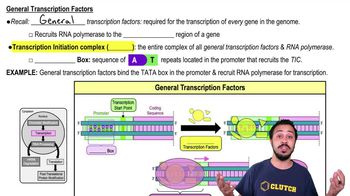
General transcription factors (GTFs) are essential proteins that assist in the initiation of transcription by RNA polymerase in eukaryotic cells. They bind to specific DNA sequences at the promoter region of genes, facilitating the assembly of the transcription machinery. GTFs are necessary for the transcription of all protein-coding genes and play a crucial role in regulating gene expression.
Recommended video:
Guided course
03:51
General Transcription Factors

Sigma Factor

Sigma factors are a type of protein found in prokaryotes that are crucial for the initiation of transcription. They bind to RNA polymerase and direct it to specific promoter regions on the DNA, allowing the enzyme to initiate transcription. Different sigma factors can recognize different promoters, enabling bacteria to adapt their gene expression in response to environmental changes.
Recommended video:
Guided course
01:39
Density-Independent Factors

Comparison of GTFs and Sigma Factors

While both general transcription factors and sigma factors are involved in the initiation of transcription, they operate in different organisms and contexts. GTFs are part of the complex transcription machinery in eukaryotes, requiring multiple factors for transcription initiation, whereas sigma factors are simpler and function in prokaryotes, directly guiding RNA polymerase to the promoter. This distinction highlights the complexity of eukaryotic transcription compared to the more streamlined process in prokaryotes.
Recommended video:
Guided course
01:39
Density-Independent Factors