
Pearson+ LogoPearson+ Logo
Ch. 2 - Water and Carbon: The Chemical Basis of Life
Freeman - Biological Science 7th Edition
Freeman7th EditionBiological ScienceISBN: 9783584863285Not the one you use?Change textbook
Chapter 2, Problem 1

Which of the following occurs when a covalent bond forms?
a. Electrons in valence shells are transferred from one atom to another.
b. Electrons in valence shells are shared between atoms.
c. Partial charges on polar molecules interact.
d. Nonpolar molecules are pushed together.by surrounding water molecules.

Verified step by step guidance
1
Understand the definition of a covalent bond: A covalent bond is a type of chemical bond where atoms share pairs of electrons in their valence shells to achieve stability, typically filling their outermost electron shells.
Analyze the options provided: Option (a) describes electron transfer, which is characteristic of ionic bonds, not covalent bonds. Option (b) describes electron sharing, which is the hallmark of covalent bonds. Option (c) refers to interactions between partial charges in polar molecules, which is related to hydrogen bonding or dipole interactions, not covalent bonding. Option (d) describes hydrophobic interactions, which occur when nonpolar molecules are pushed together in aqueous environments, unrelated to covalent bonding.
Focus on the correct characteristic of covalent bonds: Electrons are shared between atoms in covalent bonds, allowing them to achieve a stable electron configuration.
Eliminate incorrect options: Based on the definitions and characteristics of the options, rule out (a), (c), and (d) as they do not describe covalent bonding.
Conclude that the correct answer is the option that describes the sharing of electrons in valence shells, which is option (b).

Verified video answer for a similar problem:

This video solution was recommended by our tutors as helpful for the problem above.
Video duration:
1m
Was this helpful?

Key Concepts

Here are the essential concepts you must grasp in order to answer the question correctly.

Covalent Bonding

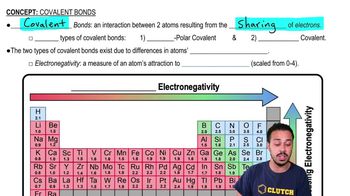
Covalent bonding occurs when two atoms share one or more pairs of electrons in their outermost shells, known as valence shells. This sharing allows each atom to attain a more stable electronic configuration, often resembling that of noble gases. Covalent bonds can be single, double, or triple, depending on the number of shared electron pairs.
Recommended video:
Guided course
04:28
Covalent Bonds

Valence Electrons

Valence electrons are the electrons located in the outermost shell of an atom and are crucial for chemical bonding. The number of valence electrons determines how an atom interacts with others, influencing its ability to form bonds. Atoms tend to bond in ways that allow them to achieve a full valence shell, typically consisting of eight electrons, known as the octet rule.
Recommended video:
Guided course
07:41
Electron Transport Chain

Polar and Nonpolar Molecules

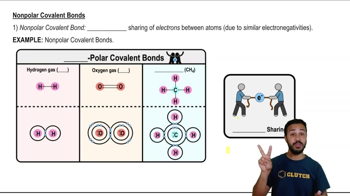
Molecules can be classified as polar or nonpolar based on the distribution of electrical charge. Polar molecules have an uneven distribution of charge, leading to partial positive and negative charges, while nonpolar molecules have an even distribution. This distinction affects how molecules interact with each other, particularly in the presence of solvents like water, which can influence the behavior of solutes.
Recommended video:
Guided course
06:41
Nonpolar Covalent Bonds