

Pearson+ LogoPearson+ Logo
Ch. 22 - Evolution by Natural Selection
Freeman - Biological Science 7th Edition
Freeman7th EditionBiological ScienceISBN: 9783584863285Not the one you use?Change textbook
Chapter 22, Problem 14

A team led by evolutionary biologist Hopi Hoekstra set out to test the hypothesis that predators are an agent of natural selection on mouse color. They made 250 plasticine models of mice that were alike in every way except that half were painted white and half were painted brown. Suggest one advantage and one disadvantage of using model mice instead of real mice in this experiment.

Verified step by step guidance
1
Identify the purpose of using models: The primary reason for using plasticine models in this experiment is to simulate how predators interact with mice of different colors without putting actual mice at risk.
Consider the advantage of using model mice: One advantage is the control over variables. By using models, the experiment ensures that the only variable differing between the two sets of mice is their color. This helps in isolating the effect of color on predator behavior, providing clearer results on the impact of color as a selective trait.
Reflect on the realism of the models: Another advantage is the ethical aspect. Using plasticine models prevents harm to real mice, adhering to ethical standards in scientific research.
Think about the disadvantage of using model mice: One major disadvantage is the lack of behavioral responses. Real mice might react to the presence of a predator by moving or hiding, which could influence a predator's response. The static nature of the models cannot mimic these potentially crucial aspects of predator-prey interactions.
Evaluate the impact of the disadvantage: This lack of behavioral realism might lead to results that do not fully capture the dynamics of natural selection, as predator interactions with live prey can be influenced by factors other than color, such as movement, smell, or sound.

Verified video answer for a similar problem:

This video solution was recommended by our tutors as helpful for the problem above.
Video duration:
1m
Was this helpful?

Key Concepts

Here are the essential concepts you must grasp in order to answer the question correctly.

Natural Selection

Natural selection is a fundamental mechanism of evolution, where organisms better adapted to their environment tend to survive and reproduce more than those less suited. In this context, the color of the mice serves as a variable that may influence predation rates, thereby affecting survival and reproductive success. Understanding this concept is crucial for evaluating how color variations can impact the fitness of the mice in their natural habitat.
Recommended video:
04:43
Natural Selection

Experimental Design

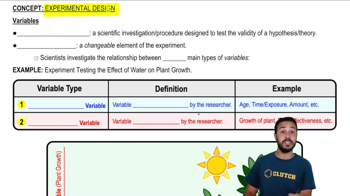
Experimental design refers to the process of planning an experiment to ensure that it effectively tests a hypothesis. In this case, using model mice allows researchers to control variables such as size and shape while isolating color as the primary factor. A well-structured experimental design is essential for drawing valid conclusions about the effects of color on predation.
Recommended video:
Guided course
02:50
Experimental Design Example 1

Ethical Considerations in Research

Ethical considerations in research involve the moral implications of using live animals in experiments. By using model mice instead of real ones, researchers can avoid potential harm to living creatures, which is a significant advantage. However, this approach may also limit the ecological validity of the findings, as models may not fully replicate the complexities of real animal behavior and interactions in their environment.
Recommended video:
Related Practice
Textbook Question
Most mice living on the mainland of Florida are brown, but the mice that live on the sand dunes of the barrier islands have white fur. The differences in color are heritable, determined by genes such as MC1R. It is intuitive that the light color of beach-dwelling mice is an adaptation for blending into their environment—and thus evading predators.Compare how evolution by inheritance of acquired characters and the theory of evolution by natural selection would explain the observation of white mice living primarily on light soil and brown mice living primarily on dark soil.
1323
views
Textbook Question

What is an evolutionary adaptation?

a. A trait that improves the fitness of its bearer, compared with individuals without the trait

b. A trait that changes in response to environmental influences within the individual's lifetime

c. The ability of an individual to adjust to its environment

d. A trait that an individual wants so that it can survive

1179
views
Textbook Question

Most mice living on the mainland of Florida are brown, but the mice that live on the sand dunes of the barrier islands have white fur. The differences in color are heritable, determined by genes such as MC1R. It is intuitive that the light color of beach-dwelling mice is an adaptation for blending into their environment—and thus evading predators. Apply Darwin's four postulates to a population of mice living on sand dunes in coastal Florida.

1086
views
Textbook Question
The researchers placed white and brown mouse models both in abandoned fields on the mainland (dark soil) and on sand dunes on the islands (light soil) and then measured the percentage of models that were attacked by predators. What is the take-home message of the data? Do the data support or reject the hypothesis that mouse color is adaptive?

1142
views