Pearson+ LogoPearson+ Logo
Ch. 25 - Phylogenies and the History of Life
Freeman - Biological Science 7th Edition
Freeman7th EditionBiological ScienceISBN: 9783584863285Not the one you use?Change textbook
Chapter 25, Problem 4

Which of the following is an example of homoplasy?
a. Hair in humans and fur in mice
b. Astragalus ankle bones in hippos and deer
c. Hox genes in humans and flies
d. Streamlined bodies in dolphins and ichthyosaurs

Verified step by step guidance
1
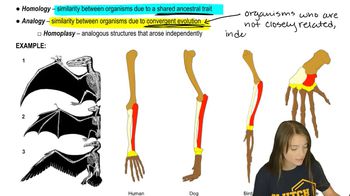
Understand the concept of homoplasy: Homoplasy refers to a trait that is similar in two species due to convergent evolution, not because of shared ancestry.
Analyze option a: Hair in humans and fur in mice are similar traits, but they are due to shared ancestry, not convergent evolution. This is an example of homology, not homoplasy.
Evaluate option b: Astragalus ankle bones in hippos and deer are similar due to shared ancestry, making them homologous structures, not homoplasy.
Consider option c: Hox genes in humans and flies are similar due to shared ancestry and are examples of homology, not homoplasy.
Examine option d: Streamlined bodies in dolphins and ichthyosaurs are similar due to convergent evolution, as both adapted to aquatic environments independently. This is an example of homoplasy.

Verified video answer for a similar problem:

This video solution was recommended by our tutors as helpful for the problem above.
Video duration:
3m
Was this helpful?

Key Concepts

Here are the essential concepts you must grasp in order to answer the question correctly.

Homoplasy

Homoplasy refers to a trait that appears similar in two species but is not derived from a common ancestor. This similarity arises due to convergent evolution, where different species independently evolve similar traits as adaptations to similar environments or ecological niches. An example is the streamlined bodies of dolphins and ichthyosaurs, which evolved independently in response to aquatic life.
Recommended video:
Guided course
15:37
Homology and Homoplasy

Convergent Evolution

Convergent evolution is the process where organisms not closely related independently evolve similar traits as a result of having to adapt to similar environments or ecological roles. This leads to the development of analogous structures, which serve similar functions but do not share a common ancestral origin. Streamlined bodies in dolphins and ichthyosaurs are a classic example of convergent evolution.
Recommended video:
Guided course
05:22
Convergent and Divergent Evolution

Analogous Structures

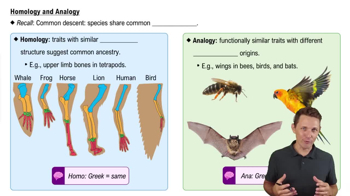
Analogous structures are features in different species that perform a similar function but do not share a common ancestral origin. These structures arise due to convergent evolution, where species adapt to similar environmental challenges. For instance, the wings of bats and birds are analogous, as they serve the same function of flight but evolved independently in these lineages.
Recommended video:
04:35
Homology and Analogy
Related Practice
Textbook Question

Choose the best definition of a fossil.

a. A rock that contains information about an organism

b. A bone, tooth, shell, or other hard part of an organism that has been preserved

c. Any trace of an organism that lived in the past

d. Any part of a dead organism

710
views
Textbook Question

Critique the following statement: The absence of a trait cannot be used as a synapomorphy in phylogenetic analysis; only shared derived traits that are present in the clade can be used.

862
views
Textbook Question

Which of the following best characterizes an adaptive radiation?

a. Descendant species occupy a large geographic area.

b. A single lineage diversifies rapidly, and descendant species occupy many habitats and ecological roles.

c. Natural selection is particularly intense, because disruptive selection occurs.

d. Species recover after a mass extinction.

770
views
Textbook Question

What important assumption does parsimony make when assessing which phylogenetic tree is most accurate? Why was parsimony misleading in the case of the astragalus during the evolution of artiodactyls?

962
views
Textbook Question

You can use a 'one-snip test' to identify monophyletic groups—meaning that if you 'cut' any branch on a tree, everything that 'falls off' is a monophyletic group. Why is this valid?

2176
views
Textbook Question

Fossilization continues even today. If you wanted to increase the probability that your deceased favorite pet would become fossilized, what actions would you take?

a. Place the corpse in an environment where decomposition is rapid (such as a forest).

b. Place the corpse in an environment where decomposition is slow (such as a swamp or bog).

c. Place the corpse in an environment where there are plenty of rocks (such as a boulder field).

d. Place the corpse in an environment where plenty of oxygen is available (such as in a mountain stream).

1150
views