Pearson+ LogoPearson+ Logo
Ch. 27 - Diversification of Eukaryotes
Freeman - Biological Science 7th Edition
Freeman7th EditionBiological ScienceISBN: 9783584863285Not the one you use?Change textbook
Chapter 27, Problem 11

When placed at the perimeter of a maze with food in the center, the plasmodial slime mold Physarum polycephalum explores the maze, retracts branches from dead-end corridors, and then grows exclusively along the shortest path possible to the food. How does Physarum do this? One theory is that it leaves behind slime deposits—an externalized 'memory' that 'reminds' it not to retry dead ends.Which of the following best describes movement in Physarum?a. Cilia propel the slime mold.b. Flagella propel the slime mold.c. The slime mold moves by amoeboid motion.d. The slime mold moves by gliding motility.

Verified step by step guidance
1
Understand the nature of Physarum polycephalum: It is a slime mold, which is a unique organism that exhibits characteristics of both fungi and amoebae.
Identify the type of movement associated with amoebae: Amoeboid motion involves the extension and retraction of pseudopodia, which are temporary projections of the cell's cytoplasm.
Relate the movement of Physarum to amoeboid motion: Physarum polycephalum moves by extending pseudopodia to navigate its environment, similar to amoeboid movement.
Eliminate incorrect options: Cilia and flagella are not involved in the movement of slime molds like Physarum, which do not have these structures.
Conclude the correct movement type: Since Physarum polycephalum moves by extending and retracting parts of its body to navigate, the best description of its movement is amoeboid motion.

Verified video answer for a similar problem:

This video solution was recommended by our tutors as helpful for the problem above.
Video duration:
1m
Was this helpful?

Key Concepts

Here are the essential concepts you must grasp in order to answer the question correctly.

Amoeboid Motion

Amoeboid motion is a type of movement characteristic of certain cells, including slime molds, where the organism extends its cytoplasm to form pseudopodia. This allows the organism to flow and change shape, effectively enabling it to move toward food sources or navigate through environments. This form of locomotion is crucial for Physarum polycephalum as it explores its surroundings in search of nutrients.
Recommended video:
Guided course
04:07
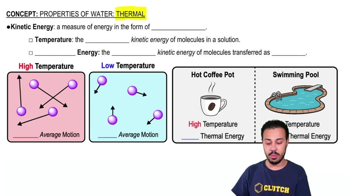
Properties of Water- Thermal

Gliding Motility

Gliding motility refers to a type of movement observed in some microorganisms, including slime molds, where they move smoothly over surfaces without the use of flagella or cilia. This movement is often facilitated by the secretion of a slimy film that reduces friction, allowing the organism to travel efficiently. In the context of Physarum polycephalum, gliding motility plays a significant role in its ability to explore and navigate mazes.
Recommended video:

Externalized Memory

Externalized memory in the context of Physarum polycephalum refers to the slime deposits it leaves behind as it moves. These deposits serve as a chemical trail that informs the organism about previously explored paths, effectively preventing it from retracing dead ends. This mechanism enhances its ability to find the shortest route to food, showcasing a form of problem-solving behavior in a simple organism.
Recommended video:
Guided course
07:41
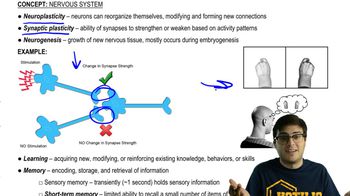
Neuroplasticity, Learning, and Memory
Related Practice
Textbook Question

The text claims that the evolutionary history of protists can be understood as a series of morphological innovations that established seven distinct lineages, each of which subsequently diversified based on innovative ways of feeding, moving, and reproducing. Explain how the Alveolata support this claim.

789
views
Textbook Question

Consider the following:

Plasmodium has an unusual organelle called an apicoplast. Recent research has shown that apicoplasts are derived from chloroplasts via secondary endosymbiosis and have a large number of genes related to chloroplast DNA.

Glyphosate is one of the most widely used herbicides. It works by poisoning an enzyme located in chloroplasts.

Biologists are testing the hypothesis that glyphosate could be used as an antimalarial drug in humans.

How are these observations connected?

622
views
Textbook Question

Suppose a friend says that we don't need to worry about the rising temperatures associated with global climate change. She claims that increased temperatures will make planktonic algae grow faster and that carbon dioxide (CO2) will be removed from the atmosphere faster. According to her, this carbon will be buried at the bottom of the ocean in calcium carbonate shells. As a result, the amount of carbon dioxide in the atmosphere will decrease and global warming will decline. Comment.

629
views
Textbook Question

When placed at the perimeter of a maze with food in the center, the plasmodial slime mold Physarum polycephalum explores the maze, retracts branches from dead-end corridors, and then grows exclusively along the shortest path possible to the food. How does Physarum do this? One theory is that it leaves behind slime deposits—an externalized 'memory' that 'reminds' it not to retry dead ends. Which of the following best describes movement in Physarum?

a. Cilia propel the slime mold.

b. Flagella propel the slime mold.

c. The slime mold moves by amoeboid motion.

d. The slime mold moves by gliding motility.

572
views
Textbook Question

<Image>

When placed at the perimeter of a maze with food in the center, the plasmodial slime mold Physarum polycephalum explores the maze, retracts branches from dead-end corridors, and then grows exclusively along the shortest path possible to the food. How does Physarum do this? One theory is that it leaves behind slime deposits—an externalized 'memory' that 'reminds' it not to retry dead ends.

Physarum is a plasmodial slime mold, whereas Dictyostelum is a cellular slime mold. Compare and contrast movement by the migrating slug stage of Dictyostelium to the plasmodial stage of Physarum.

642
views
Textbook Question

<Image>

When placed at the perimeter of a maze with food in the center, the plasmodial slime mold Physarum polycephalum explores the maze, retracts branches from dead-end corridors, and then grows exclusively along the shortest path possible to the food. How does Physarum do this? One theory is that it leaves behind slime deposits—an externalized 'memory' that 'reminds' it not to retry dead ends.

Does an organism without a brain have the ability to use an externalized 'memory'—a spatial 'slime map' that the organism uses to avoid moving to regions where it has been before? Researchers addressed this question by placing a U-shaped trap between Physarum and its food (see diagram that follows). Twenty-three out of 24 slime molds reached the food when plain agar was used as the growth substrate. However, when the agar was coated with extracellular slime, only 8 of 24 found the food. The mean time in hours that it took the successful slime molds to reach the food when placed on plain agar or agar pre-coated with extracellular slime was compared (P=0.012). Use the P value provided to determine if the difference is significant or not. What conclusion can be drawn from the graph shown here?

<Image>

827
views