Pearson+ LogoPearson+ Logo
Ch. 30 - An Introduction to Animals
Freeman - Biological Science 7th Edition
Freeman7th EditionBiological ScienceISBN: 9783584863285Not the one you use?Change textbook
Chapter 30, Problem 1

Which synapomorphy (shared, derived trait) distinguishes animals as a monophyletic group, distinct from choanoflagellates?
a. Multicellularity
b. Coloniality
c. Heterotrophy
d. Movement

Verified step by step guidance
1
Understand the concept of synapomorphy: A synapomorphy is a shared, derived trait that is used to determine evolutionary relationships among organisms, indicating a common ancestor.
Identify the characteristics of choanoflagellates: Choanoflagellates are single-celled organisms that are considered the closest living relatives of animals. They exhibit coloniality but are not truly multicellular.
Examine the traits listed in the options: Multicellularity, coloniality, heterotrophy, and movement.
Determine which trait is unique to animals and not present in choanoflagellates: Consider that animals are defined by their multicellular structure, which is a key synapomorphy distinguishing them from choanoflagellates.
Conclude that multicellularity is the synapomorphy that distinguishes animals as a monophyletic group, setting them apart from choanoflagellates.

Verified video answer for a similar problem:

This video solution was recommended by our tutors as helpful for the problem above.
Video duration:
58s
Was this helpful?

Key Concepts

Here are the essential concepts you must grasp in order to answer the question correctly.

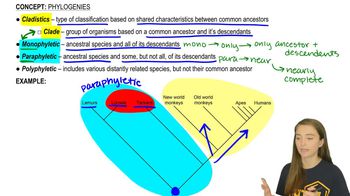
Synapomorphy

A synapomorphy is a shared, derived trait that is used to determine evolutionary relationships among organisms. It is a characteristic present in an ancestral species and shared exclusively by its evolutionary descendants, helping to define a monophyletic group. Understanding synapomorphies is crucial for distinguishing between different evolutionary lineages.
Recommended video:

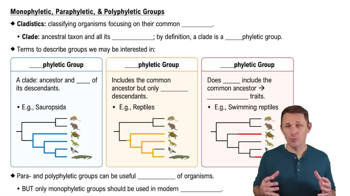
Monophyletic Group

A monophyletic group, also known as a clade, consists of an ancestor and all its descendants, representing a single branch on the tree of life. This concept is essential for classifying organisms based on common ancestry, ensuring that all members of the group share a unique evolutionary trait, such as a synapomorphy.
Recommended video:
06:37
Monophyletic, Paraphyletic, & Polyphyletic Group

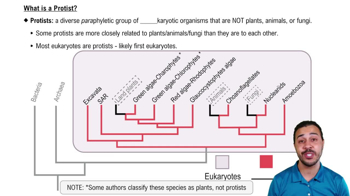
Choanoflagellates

Choanoflagellates are single-celled or colonial protists considered the closest living relatives of animals. They share some features with animals, such as similar cell structures, but lack certain derived traits that define animals as a distinct monophyletic group. Understanding their relationship with animals helps clarify the evolutionary transition from unicellular to multicellular life forms.
Recommended video:
Guided course
03:23
What is a Protist?