Pearson+ LogoPearson+ Logo
Ch. 31 - Protostome Animals
Freeman - Biological Science 7th Edition
Freeman7th EditionBiological ScienceISBN: 9783584863285Not the one you use?Change textbook
Chapter 31, Problem 9

Brachiopoda is a phylum within the Lophotrochozoa. Even though they are not closely related to bivalve mollusks (such as clams or mussels), brachiopods look and act like bivalve mollusks. Specifically, brachiopods suspension feed, secrete calcium carbonate shells with two valves that hinge together in some species, and attach to rocks or other hard surfaces on the ocean floor. How is it possible for brachiopods and bivalves to be so similar if they did not share a recent common ancestor?

Verified step by step guidance
1
Understand the concept of convergent evolution, which explains how organisms that do not share a recent common ancestor can develop similar traits. This occurs because they adapt to similar environmental challenges and selective pressures.
Examine the habitats of both brachiopods and bivalve mollusks. Both live in marine environments where they attach to substrates and are filter feeders. This similar lifestyle leads to similar adaptations despite their different evolutionary paths.
Explore the structural similarities and differences between brachiopods and bivalves. While both have two shells (valves), the orientation and mechanism of opening and closing these shells differ, reflecting their distinct evolutionary origins.
Investigate the feeding mechanisms of brachiopods and bivalves. Both use filter feeding to capture food particles from the water, which is an effective strategy in their aquatic environments and contributes to their superficial resemblance.
Consider the role of natural selection in shaping the form and function of organisms. Natural selection can lead to similar solutions (like shell development for protection and filter feeding for nutrition) in unrelated groups when faced with similar environmental challenges.

Verified video answer for a similar problem:

This video solution was recommended by our tutors as helpful for the problem above.
Video duration:
1m
Was this helpful?

Key Concepts

Here are the essential concepts you must grasp in order to answer the question correctly.

Convergent Evolution

Convergent evolution occurs when unrelated species develop similar traits or adaptations due to similar environmental pressures or ecological niches. In the case of brachiopods and bivalves, both groups have evolved similar body structures and feeding mechanisms, such as suspension feeding and shell formation, despite not sharing a recent common ancestor. This phenomenon highlights how different evolutionary paths can lead to analogous features.
Recommended video:
Guided course
05:22
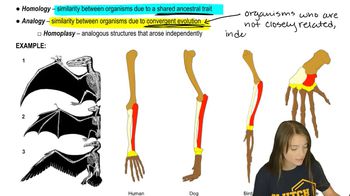
Convergent and Divergent Evolution

Homoplasy

Homoplasy refers to traits that are similar in different species but do not arise from a common ancestor. This can occur through convergent evolution or evolutionary reversals. The similarities between brachiopods and bivalves, such as their shell structure and feeding strategies, exemplify homoplasy, as these traits evolved independently in response to similar environmental challenges.
Recommended video:
Guided course
15:37
Homology and Homoplasy

Phylogenetics

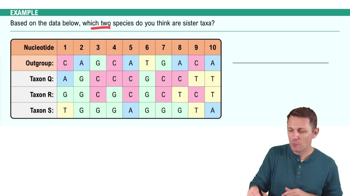
Phylogenetics is the study of evolutionary relationships among biological species based on genetic, morphological, or behavioral data. Understanding the phylogenetic tree helps clarify how different organisms are related and the timing of their divergence. In the context of brachiopods and bivalves, phylogenetic analysis reveals that their similarities are not due to close evolutionary ties but rather to adaptations to similar ecological roles.
Recommended video:
04:13
Building Phylogenetic Trees Example 2
Related Practice
Textbook Question

Evaluate this statement: Evolution is said to occur when new traits accumulate over time, increasing complexity.

639
views
Textbook Question

Brachiopoda is a phylum within the Lophotrochozoa. Even though they are not closely related to bivalve mollusks (such as clams or mussels), brachiopods look and act like bivalve mollusks. Specifically, brachiopods suspension feed, secrete calcium carbonate shells with two valves that hinge together in some species, and attach to rocks or other hard surfaces on the ocean floor. How is it possible for brachiopods and bivalves to be so similar if they did not share a recent common ancestor?

710
views
Textbook Question
Suppose that a gene originally identified in nematodes (roundworms) is found to be homologous with a gene that can cause developmental abnormalities in humans. Would it be possible to use fruit flies as a model organism to study this gene? Explain.
810
views
Textbook Question

About a third of insect species measured are in decline, meaning that their populations are shrinking due to habitat destruction, pollution, and other factors. Predict how this change affects the bee pollination of crops such as apples and almonds.

1204
views
Textbook Question

A team of 102 scientists spent a year surveying a small area of the San Lorenzo rain forest in Panama to count the number of species of arthropods living there. After collecting 129,494 specimens—using nets, traps, shovels, tree-climbing harnesses, helium balloons, and other creative gear—it took the team eight years to sort and identify the arthropods. Which of the following nested groups best describes the taxonomic context for the San Lorenzo project?

a. Animalia > Bilateria > Arthropoda > Ecdysozoa

b. Protostomia > Lophotrochozoa > Ecdysozoa > Arthropoda

c. Arthropoda > Protostomia > Ecdysozoa > Bilateria

d. Bilateria > Protostomia > Ecdysozoa > Arthropoda

736
views
Textbook Question

A team of 102 scientists spent a year surveying a small area of the San Lorenzo rain forest in Panama to count the number of species of arthropods living there. After collecting 129,494 specimens—using nets, traps, shovels, tree-climbing harnesses, helium balloons, and other creative gear—it took the team eight years to sort and identify the arthropods. Rather than measuring the entire 6000-hectare (ha) forest, the researchers sampled arthropod diversity by intensively collecting as many arthropods as they could in 12 plots that measured 20 m × 20m square. If 1 ha=10,000 m², how many hectares of forest did they sample in all?

a. 20 m×20 m×12=4800 ha

b. 4800 m²×10,000 m²/1 ha=48,000,000 ha

c. 20 m×20 m=400 ha

d. 4800 m² x ha/10,000 m² = 0.48 ha

568
views