

Pearson+ LogoPearson+ Logo
Ch. 33 - Viruses
Freeman - Biological Science 7th Edition
Freeman7th EditionBiological ScienceISBN: 9783584863285Not the one you use?Change textbook
Chapter 33, Problem 13

The mosquito-borne Zika virus (ZIKV) is one of the most feared viruses for pregnant women. Recent statistics justify this fear: Infants born to mothers infected with ZIKV during pregnancy face a risk of up to 42 percent of developing birth defects, including microcephaly (an abnormally small head and decreased brain volume). What do we know about how ZIKV causes damage to the developing brain?Several lines of evidence suggest that after ZIKV is transmitted to a pregnant woman via the bite of an infected mosquito, the virus then directly infects cells of the placenta, gaining access to the fetal brain. Following attachment, the virion would most likely enter the placental cellby:a. insertion via the mosquito's mouthpartsb. endocytosisc. degrading the cell wall with lysozymed. injection through a hollow, needle-like protein structure

Verified step by step guidance
1
Understand the nature of Zika virus (ZIKV) and its transmission method. ZIKV is transmitted through the bite of an infected mosquito and can infect pregnant women.
Recognize the target of ZIKV after transmission. Once a pregnant woman is infected, the virus can target the placenta, which is crucial for providing nutrients and oxygen to the developing fetus.
Identify the potential entry mechanisms of ZIKV into placental cells. The virus needs to enter these cells to reach the fetal environment.
Evaluate the listed options for how ZIKV might enter placental cells: a) insertion via the mosquito's mouthparts, b) endocytosis, c) degrading the cell wall with lysozyme, d) injection through a hollow, needle-like protein structure.
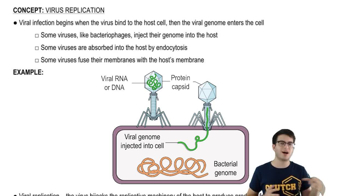
Consider the typical mechanisms of viral entry into host cells, focusing on those relevant to viruses similar to ZIKV. Viruses often enter cells through processes like endocytosis, where the cell membrane engulfs the virus.

Verified video answer for a similar problem:

This video solution was recommended by our tutors as helpful for the problem above.
Video duration:
1m
Was this helpful?

Key Concepts

Here are the essential concepts you must grasp in order to answer the question correctly.

Zika Virus Transmission

Zika virus is primarily transmitted to humans through the bite of infected Aedes mosquitoes. Once in the bloodstream, the virus can cross the placenta, leading to potential infection of the developing fetus. Understanding this transmission route is crucial for grasping how the virus can affect pregnancy and fetal development.
Recommended video:
Guided course
04:30
Virus Replication

Endocytosis

Endocytosis is a cellular process where cells engulf external substances, allowing them to enter the cell. In the context of Zika virus infection, the virus can utilize endocytosis to penetrate placental cells, facilitating its access to the fetal brain. This mechanism is vital for understanding how viruses exploit cellular pathways to infect host tissues.
Recommended video:
Guided course
02:02
Endocytosis and Exocytosis

Microcephaly and Birth Defects

Microcephaly is a condition characterized by an abnormally small head and reduced brain size, often resulting from developmental disruptions during pregnancy. Zika virus infection in pregnant women has been linked to an increased risk of microcephaly and other birth defects, highlighting the importance of studying the virus's effects on fetal brain development and the underlying mechanisms of damage.
Recommended video:
Guided course
04:09
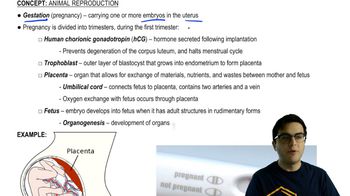
Pregnancy and Birth
Related Practice
Textbook Question

Which of the following types of viruses would you expect to require periods of latency?

a. Viruses that have large genomes and require a long time for replication

b. Viruses that require a long time for transmission to new hosts

c. Viruses that require a long time for assembly into complex structures

d. Viruses that infect cells of the immune system

920
views
Textbook Question

The mosquito-borne Zika virus (ZIKV) is one of the most feared viruses for pregnant women. Recent statistics justify this fear: Infants born to mothers infected with ZIKV during pregnancy face a risk of up to 42 percent of developing birth defects, including microcephaly (an abnormally small head and decreased brain volume).

What do we know about how ZIKV causes damage to the developing brain?

ZIKV is a Baltimore class IV virus. Based on this classification, what do you know about the structure of its genome?

1046
views
Textbook Question

The mosquito-borne Zika virus (ZIKV) is one of the most feared viruses for pregnant women. Recent statistics justify this fear: Infants born to mothers infected with ZIKV during pregnancy face a risk of up to 42 percent of developing birth defects, including microcephaly (an abnormally small head and decreased brain volume).

What do we know about how ZIKV causes damage to the developing brain?

Researchers have determined that host cells possess several different surface proteins that can serve as virus receptors for ZIKV. If you were to repeat the experiment described in Figure 33.8 using ZIKV instead of HIV, how would you expect the results to be different? Explain.

1033
views
Textbook Question

The mosquito-borne Zika virus (ZIKV) is one of the most feared viruses for pregnant women. Recent statistics justify this fear: Infants born to mothers infected with ZIKV during pregnancy face a risk of up to 42 percent of developing birth defects, including microcephaly (an abnormally small head and decreased brain volume). What do we know about how ZIKV causes damage to the developing brain? Researchers recently developed a mouse model for fetal brain defects associated with human ZIKV infection. To determine the effect of ZIKV on the number of neurons in the brain, ZIKV was injected into the brains of developing mouse embryos. Neurons were identified by staining sections of brain tissue with antibodies against NeuN, a neuron-specific protein, and the number of NeuN-positive cells per mm2 in specific regions was quantified. The results of three independent experiments are shown in the graph below. Use the P value provided to determine if the difference is significant or not (* means P< 0.05). Based on these results, what can you conclude?

828
views
Textbook Question
The mosquito-borne Zika virus (ZIKV) is one of the most feared viruses for pregnant women. Recent statistics justify this fear: Infants born to mothers infected with ZIKV during pregnancy face a risk of up to 42 percent of developing birth defects, including microcephaly (an abnormally small head and decreased brain volume). What do we know about how ZIKV causes damage to the developing brain?Traveling and tourism have been badly affected in ZIKV-affected countries. What advice would you give a friend planning a trip to the Caribbean?
832
views
Textbook Question

The mosquito-borne Zika virus (ZIKV) is one of the most feared viruses for pregnant women. Recent statistics justify this fear: Infants born to mothers infected with ZIKV during pregnancy face a risk of up to 42 percent of developing birth defects, including microcephaly (an abnormally small head and decreased brain volume).

What do we know about how ZIKV causes damage to the developing brain?

Draw a model to illustrate how the Zika virus genome is used to produce new virions. In your drawing, identify the steps required to replicate the genome and those used to produce mRNA.

Also note where mRNAs that are used to produce capsid and envelope proteins are translated.

955
views