

Pearson+ LogoPearson+ Logo
Ch. 45 - Animal Movement
Freeman - Biological Science 7th Edition
Freeman7th EditionBiological ScienceISBN: 9783584863285Not the one you use?Change textbook
Chapter 45, Problem 15

Distance runner Paula Radcliffe has won dozens of long-distance races and held the women's world record for the marathon since 2003. Scientists, trainers, and athletes alike have wondered about the extent to which muscle structure and function contribute to success in athletes such as Radcliffe. What makes elite distance runners so good? Are their muscles somehow different from those of less successful athletes and non-athletes?The researchers looked more closely at the data within the group of elite runners. Although the mean proportion of slow fibers was 79 percent in this group, individual values ranged from 27percent in one runner to 98 percent in another. How does this finding affect your interpretation of the relationship between athletic performance and muscle-fiber types?

Verified step by step guidance
1
Understand the types of muscle fibers: Muscle fibers can be broadly categorized into slow-twitch (Type I) and fast-twitch (Type II). Slow-twitch fibers are more efficient at using oxygen to generate more fuel (known as ATP) for continuous, extended muscle contractions over a long time. They are ideal for endurance sports like long-distance running.
Analyze the data variability: The data shows a wide range of slow-twitch fiber proportions among elite runners, from 27 percent to 98 percent. This suggests that while a higher proportion of slow-twitch fibers might be beneficial for endurance, there are successful elite runners with a lower proportion of these fibers.
Consider other contributing factors: Since there is such a wide range in the proportion of slow-twitch fibers, it implies that other factors also play significant roles in determining athletic performance. These could include training, diet, mental stamina, and other genetic factors.
Evaluate the role of fast-twitch fibers: Even though slow-twitch fibers are more efficient for endurance, fast-twitch fibers are crucial for generating short bursts of speed and power, which can also be beneficial during certain phases of a race, such as the final sprint.
Synthesize the findings: The variability in muscle fiber composition among elite runners indicates that there is no single 'ideal' muscle makeup for distance running. Success in long-distance running likely results from a complex interaction between various physical, genetic, and psychological factors.

Verified video answer for a similar problem:

This video solution was recommended by our tutors as helpful for the problem above.
Video duration:
4m
Was this helpful?

Key Concepts

Here are the essential concepts you must grasp in order to answer the question correctly.

Muscle Fiber Types

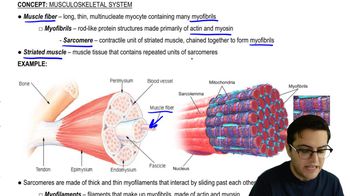
Muscle fibers are categorized into two main types: slow-twitch (Type I) and fast-twitch (Type II). Slow-twitch fibers are more efficient for endurance activities, as they are fatigue-resistant and utilize oxygen effectively for energy production. In contrast, fast-twitch fibers are geared towards short bursts of power and speed but fatigue quickly. Understanding the distribution of these fiber types in athletes can provide insights into their performance capabilities.
Recommended video:
Guided course
02:40
Muscle Fibers and Sarcomeres

Genetic Variation in Muscle Composition

Genetic factors play a significant role in determining an individual's muscle fiber composition. Variability in the proportion of slow and fast fibers among athletes suggests that genetics can influence endurance performance. This genetic predisposition may explain why some elite distance runners, like Paula Radcliffe, have a higher percentage of slow-twitch fibers, enhancing their ability to sustain prolonged physical activity compared to less successful athletes.
Recommended video:
02:26
Genetic Variation Example 1

Performance and Muscle Fiber Proportions

The relationship between muscle fiber types and athletic performance is complex. While a higher proportion of slow-twitch fibers is generally associated with better endurance performance, individual variations can lead to different outcomes. The finding that elite runners have a wide range of slow fiber percentages indicates that other factors, such as training, technique, and mental resilience, also significantly contribute to athletic success, beyond just muscle composition.
Recommended video:
Guided course
02:40
Muscle Fibers and Sarcomeres
Related Practice
Textbook Question

Distance runner Paula Radcliffe has won dozens of long-distance races and held the women's world record for the marathon since 2003. Scientists, trainers, and athletes alike have wondered about the extent to which muscle structure and function contribute to success in athletes such as Radcliffe.

What makes elite distance runners so good?

Are their muscles somehow different from those of less successful athletes and non-athletes?

Predict who would likely have a greater proportion of fast glycolytic fibers in their gastrocnemius (calf) muscle—an elite distance runner or an elite sprinter. Explain.

886
views
Textbook Question

Distance runner Paula Radcliffe has won dozens of long-distance races and held the women's world record for the marathon since 2003. Scientists, trainers, and athletes alike have wondered about the extent to which muscle structure and function contribute to success in athletes such as Radcliffe.

What makes elite distance runners so good? Are their muscles somehow different from those of less successful athletes and non-athletes?

Predict the effect of training for a marathon on the number of muscle cells in the gastrocnemius. Explain.

1032
views
Textbook Question

Distance runner Paula Radcliffe has won dozens of long-distance races and held the women's world record for the marathon since 2003. Scientists, trainers, and athletes alike have wondered about the extent to which muscle structure and function contribute to success in athletes such as Radcliffe.

What makes elite distance runners so good?

Are their muscles somehow different from those of less successful athletes and non-athletes?

To discover the relationship between muscle-fiber types and performance, researchers obtained tiny biopsies of the gastrocnemius of 14 elite distance runners, 18 trained but non-elite distance runners, and 19 untrained subjects. They categorized the fiber types as slow or fast. (At the time of the study, intermediate fibers had not been identified as a third type.) Some of their data are shown here (* means). What conclusions can you draw from these data?

1018
views
Textbook Question

Distance runner Paula Radcliffe has won dozens of long-distance races and held the women's world record for the marathon since 2003. Scientists, trainers, and athletes alike have wondered about the extent to which muscle structure and function contribute to success in athletes such as Radcliffe.

What makes elite distance runners so good?

Are their muscles somehow different from those of less successful athletes and non-athletes?

Imagine that Paula Radcliffe is racing against a bird and a fish, each with the same mass as Paula. Which organism would have the highest cost of locomotion during the race?

931
views