Pearson+ LogoPearson+ Logo
Ch. 50 - Behavioral Ecology
Freeman - Biological Science 7th Edition
Freeman7th EditionBiological ScienceISBN: 9783584863285Not the one you use?Change textbook
Chapter 50, Problem 10

J. B. S. Haldane once remarked that he'd be willing to lay down his life to save two brothers or eight cousins. Explain what he meant.

Verified step by step guidance
1
Understand the context of Haldane's remark: J.B.S. Haldane was a British geneticist and evolutionary biologist who made significant contributions to understanding how natural selection works. His statement reflects the concept of 'kin selection' in evolutionary biology.
Learn about kin selection: Kin selection is a type of natural selection that favors the reproductive success of an organism's relatives, even at a cost to the organism's own survival and reproduction. This concept helps explain altruistic behavior in the animal kingdom.
Explore the genetic relationship: Haldane's comment about saving two brothers or eight cousins refers to the proportion of genes shared by common descent. Siblings share about 50% of their genes, while first cousins share about 12.5%. Therefore, saving two brothers (2 x 50% = 100%) or eight cousins (8 x 12.5% = 100%) would theoretically save 100% of his genes through his relatives.
Understand the concept of inclusive fitness: Inclusive fitness combines an individual's own reproductive success with the reproductive success of its relatives, weighted by the genetic relatedness to those relatives. This concept provides a broader view of an organism's genetic contribution to the next generation.
Apply the concept to human behavior: While Haldane's remark was likely made with a bit of humor, it underscores the importance of genetic relatedness in the evolution of altruistic behaviors, where individuals may sacrifice their own well-being to enhance the survival chances of closely related individuals.

Verified video answer for a similar problem:

This video solution was recommended by our tutors as helpful for the problem above.
Video duration:
1m
Was this helpful?

Key Concepts

Here are the essential concepts you must grasp in order to answer the question correctly.

Kin Selection

Kin selection is an evolutionary strategy that favors the reproductive success of an organism's relatives, even at a cost to the organism's own survival and reproduction. This concept explains why individuals may act altruistically towards their family members, as helping relatives can enhance the survival of shared genes.
Recommended video:
04:43
Natural Selection

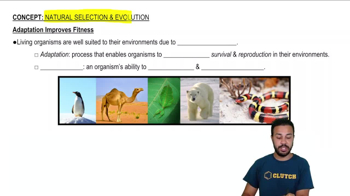
Inclusive Fitness

Inclusive fitness is a measure of an organism's genetic success based on the survival and reproduction of its relatives, in addition to its own offspring. This concept expands the traditional view of fitness by considering the impact of an individual's actions on the genetic success of their kin, thus providing a rationale for altruistic behavior.
Recommended video:
Guided course
02:57
Adaptation Improves Fitness

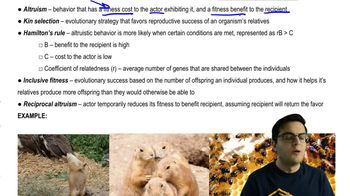
Altruism in Evolution

Altruism in evolution refers to behaviors that benefit others at a cost to oneself. In the context of Haldane's statement, it highlights the idea that individuals may prioritize the welfare of close relatives over distant ones, as the genetic ties are stronger, leading to a greater likelihood of shared genetic material being passed on to future generations.
Recommended video:
Guided course
07:15
Migration and Altruism
Related Practice
Textbook Question

Propose an evolutionary hypothesis to explain the observation that some bird populations do not migrate if people supply food for them in feeders.

675
views
Textbook Question

Hamilton's rule states that an altruistic allele could spread in a population if Br > C, where B represents the fitness benefit to the recipient, r is the coefficient of relatedness between altruist and recipient, and C represents the fitness cost to the altruist. If r = 0.5 between the altruist and the recipient, what would the ratio of costs to benefits have to be for the altruistic allele to spread?

a. C/ B > 0.5

b. C/ B > 0

c. C/ B < 0.5

d. C/ B < 0

1602
views
Textbook Question

Evolutionary biologist Hopi Hoekstra and colleagues have hypothesized that the burrow-digging behavior of mice (and the resulting shape of their underground burrows) is heritable—innate and not learned. Design an experiment to test this hypothesis.

725
views
Textbook Question

<Image>

Mass strandings of whales occur on beaches near military exercises where sonar is used, raising concerns about the effects of human-generated underwater sounds on animal behavior. Scientists are collecting behavioral data on several species of whales to find out how sonar affects them.

Whales communicate with one another using sound. What is one benefit and one cost to whales of using sound to communicate underwater?

570
views
Textbook Question

<Image>

Mass strandings of whales occur on beaches near military exercises where sonar is used, raising concerns about the effects of human-generated underwater sounds on animal behavior. Scientists are collecting behavioral data on several species of whales to find out how sonar affects them.

Researchers followed tagged blue whales to observe how they respond to simulated military sonar—using sound levels much lower than those typically used during military exercises. Analyze the sample of data below for one individual blue whale and summarize the behavioral effect of the sound exposure.

718
views
Textbook Question

<Image>

Mass strandings of whales occur on beaches near military exercises where sonar is used, raising concerns about the effects of human-generated underwater sounds on animal behavior. Scientists are collecting behavioral data on several species of whales to find out how sonar affects them.

Using the graph, estimate the number of minutes of foraging per hour before and after the sound exposure. Then predict the effect of sonar on the fitness of blue whales. Explain your reasoning.

619
views