Pearson+ LogoPearson+ Logo
Ch. 51 - Population Ecology
Freeman - Biological Science 7th Edition
Freeman7th EditionBiological ScienceISBN: 9783584863285Not the one you use?Change textbook
Chapter 51, Problem 7

Explain why biologists want to maintain (a) 'habitat corridors' that connect populations in a metapopulation, and (b) unoccupied habitat that is appropriate for the species in question.

Verified step by step guidance
1
1. Habitat corridors are important because they allow for the movement of individuals between different populations within a metapopulation. This movement, or gene flow, can help maintain genetic diversity within the metapopulation, which can increase the overall fitness and survival of the species. Without these corridors, populations can become isolated, leading to inbreeding and a decrease in genetic diversity.
2. Habitat corridors also facilitate the recolonization of habitats where local extinctions have occurred. If a population in one habitat patch goes extinct, individuals from another patch can move through the corridor to recolonize the area. This can help maintain the overall size and stability of the metapopulation.
3. Maintaining unoccupied habitats that are suitable for the species is also crucial. These habitats can act as 'refuges' or 'reserves' where the species can survive and reproduce if conditions in their current habitat become unfavorable due to factors like disease, predation, or environmental changes.
4. Unoccupied habitats can also provide opportunities for population expansion when conditions are favorable. If a population grows too large for its current habitat, individuals can disperse to the unoccupied habitat and establish a new population there.
5. In conclusion, maintaining habitat corridors and unoccupied habitats are both important strategies for conserving biodiversity and ensuring the long-term survival of species in a changing environment.

Verified video answer for a similar problem:

This video solution was recommended by our tutors as helpful for the problem above.
Video duration:
2m
Was this helpful?

Key Concepts

Here are the essential concepts you must grasp in order to answer the question correctly.

Metapopulation Dynamics

A metapopulation consists of multiple, spatially separated populations of the same species that interact through migration. Understanding metapopulation dynamics is crucial for biologists as it helps them assess how populations can persist over time despite habitat fragmentation. Habitat corridors facilitate gene flow and recolonization, which are essential for maintaining genetic diversity and population stability.
Recommended video:
Guided course
03:37
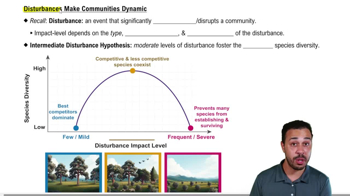
Disturbances Make Communities Dynamic

Habitat Corridors

Habitat corridors are strips of natural habitat that connect isolated populations, allowing for the movement of individuals between them. These corridors are vital for reducing the risks of inbreeding and local extinction by enabling species to access resources, mates, and new habitats. By maintaining these connections, biologists can enhance the resilience of populations against environmental changes.
Recommended video:
Guided course
03:23
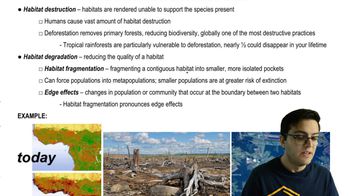
Habitat Destruction and Degradation

Conservation of Unoccupied Habitat

Conserving unoccupied habitat is essential for species recovery and long-term survival. This habitat can serve as potential sites for population expansion or reintroduction efforts, providing safe spaces for species to thrive. By ensuring that suitable habitats are preserved, biologists can support biodiversity and help mitigate the impacts of habitat loss and climate change.
Recommended video:
Guided course
03:23
Habitat Destruction and Degradation
Related Practice
Textbook Question

Why is there a trade-off between survivorship and fecundity?

1147
views
Textbook Question

Which of the following species is most likely to have a Type III survivorship curve?

a. Humans, Homo sapiens

b. Common lizards, Zootoca vivipara

c. Thale cress plants, Arabidopsis thaliana

d. Lynx cats, Lynx canadensis

1163
views
Textbook Question

Pose a hypothesis to explain why the human population has undergone especially rapid growth over the past 200 years. Describe two examples of density-dependent factors that limit human population growth. Is it possible that humans have surpassed Earth's carrying capacity?

810
views
Textbook Question

Indicate what is correct and incorrect about this statement: If lizards want to survive during climate change, they can evolve new life-history traits.

872
views
Textbook Question

When wild plant and animal populations are logged, fished, or hunted, only the oldest or largest individuals tend to be taken. Many of the commercially important species are long lived and are slow to begin reproducing. If harvesting is not regulated carefully and exploitation is intense, what impact does harvesting have on a population's age structure? How might harvesting affect the population's life table and growth rate?

1076
views
Textbook Question
Make a rough sketch of the age distribution in a developing versus a developed country, and explain why the shapes of the diagrams are different. How is AIDS, which is a sexually transmitted disease, likely affecting the age distribution in countries hard hit by the epidemic?
981
views