Join thousands of students who trust us to help them ace their exams!
Multiple Choice
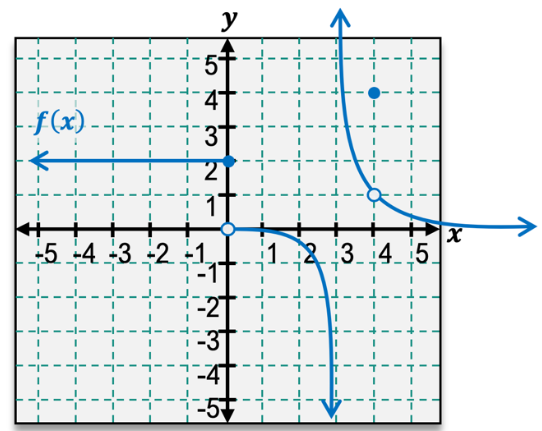
Use the graph of f(x) to determine if the function is continuous or discontinuous at x=c. c=4
A
Continuous
B
Discontinuous
0 Comments
Verified step by step guidance
1
Step 1: Recall the definition of continuity. A function is continuous at a point x = c if the following three conditions are satisfied: (1) f(c) is defined, (2) the limit of f(x) as x approaches c exists, and (3) the limit of f(x) as x approaches c is equal to f(c).
Step 2: Analyze the graph at x = 4. Observe the behavior of the function f(x) near x = 4. Check if there is a defined value for f(4) by looking for a filled dot at x = 4 on the graph.
Step 3: Check the limit of f(x) as x approaches 4 from both the left and the right. Observe the graph to see if the left-hand limit (as x approaches 4 from values less than 4) and the right-hand limit (as x approaches 4 from values greater than 4) are equal.
Step 4: Compare the value of f(4) (if defined) with the limit of f(x) as x approaches 4. If the limit exists and matches the value of f(4), the function is continuous at x = 4. If not, it is discontinuous.
Step 5: Based on the graph, determine if any of the three conditions for continuity are violated at x = 4. If any condition is violated, conclude that the function is discontinuous at x = 4.


 Verified step by step guidance

