Skip to main content
Statistics for Business
My Course
Learn
Exam Prep
AI Tutor
Study Guides
Flashcards
Explore
Try the app
My Course
Learn
Exam Prep
AI Tutor
Study Guides
Flashcards
Explore
Try the app
Back
Bar Graphs and Pareto Charts definitions
You can tap to flip the card.
Bar Graph
You can tap to flip the card.
👆
Bar Graph
A visual tool for displaying categorical data using bars whose heights or lengths represent category frequencies.
Track progress
Control buttons has been changed to "navigation" mode.
1/15
Related flashcards
Related practice
Recommended videos
Bar Graphs and Pareto Charts quiz
Bar Graphs and Pareto Charts
15 Terms
Bar Graphs and Pareto Charts
2. Describing Data with Tables and Graphs
10 problems
Topic
Ernest
Pie Charts
2. Describing Data with Tables and Graphs
10 problems
Topic
Ally
2. Describing Data with Tables and Graphs
10 topics
15 problems
Chapter
David-Paige
Guided course
04:52
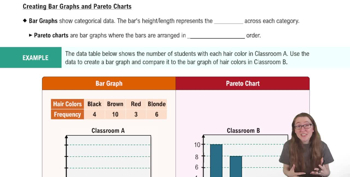
Creating Bar Graphs and Pareto Charts
368
views
8
rank
Guided course
05:26
Example 1
252
views
16
rank
Terms in this set (15)
Hide definitions
Bar Graph
A visual tool for displaying categorical data using bars whose heights or lengths represent category frequencies.
Categorical Data
Information sorted into groups or categories, such as hair color, rather than measured numerically.
Frequency
The number of times a particular category appears within a dataset, often shown by bar height.
X-Axis
The horizontal line on a graph where categories are typically placed in bar graphs.
Y-Axis
The vertical line on a graph that usually displays the frequency scale in bar graphs.
Scale
A set of evenly spaced values on an axis that helps measure and compare bar heights accurately.
Pareto Chart
A special bar graph with bars arranged in descending order to highlight the most frequent categories.
Descending Order
An arrangement from highest to lowest, used in Pareto charts to organize bars by frequency.
Category
A distinct group or label within a dataset, such as a specific hair color in a classroom.
Tick Mark
A small line on an axis indicating a value, used to help read bar heights and frequencies.
Data Table
A structured arrangement of information, often used as a source for creating bar graphs.
Trend
A noticeable pattern or direction in data, such as which category is most or least common.
Qualitative Data
Non-numeric information describing qualities or characteristics, often visualized with bar graphs.
Comparison
The act of evaluating differences or similarities between categories, often by examining bar heights.
Minimum Frequency
The lowest count of occurrences for any category in a dataset, important for setting graph scales.
 BackBack


 04:52
04:52