Skip to main content
Statistics for Business
My Course
Learn
Exam Prep
AI Tutor
Study Guides
Flashcards
Explore
Try the app
My Course
Learn
Exam Prep
AI Tutor
Study Guides
Flashcards
Explore
Try the app
Back
Basic Concepts of Probability definitions
You can tap to flip the card.
Probability
You can tap to flip the card.
👆
Probability
A numerical measure expressing the likelihood of an event, ranging from 0 (impossible) to 1 (certain).
Track progress
Control buttons has been changed to "navigation" mode.
1/14
Related flashcards
Related practice
Recommended videos
Basic Concepts of Probability quiz #1
Basic Concepts of Probability
10 Terms
Basic Concepts of Probability
4. Probability
10 problems
Topic
Ernest
Complements
4. Probability
10 problems
Topic
Ernest
4. Probability
9 topics
15 problems
Chapter
Ernest
5:37
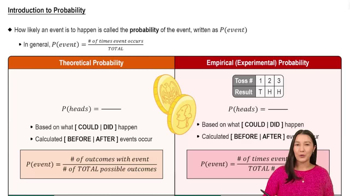
Introduction to Probability
822
views
27
rank
Terms in this set (14)
Hide definitions
Probability
A numerical measure expressing the likelihood of an event, ranging from 0 (impossible) to 1 (certain).
Event
Any outcome or set of outcomes that can occur in a probability experiment, regardless of size or significance.
Theoretical Probability
A value calculated using possible outcomes before any experiment, based on logical reasoning or known possibilities.
Empirical Probability
A value determined from observed data after conducting trials or experiments, reflecting actual results.
Sample Space
A set containing all possible outcomes of a probability experiment, often shown using curly brackets.
Outcome
A single possible result from a probability experiment, such as rolling a specific number on a die.
Trial
A single performance or repetition of a probability experiment, such as one coin flip or one die roll.
Set Notation
A mathematical way to list all possible outcomes of an experiment, typically using curly brackets.
Fraction
A numerical representation used to express probability, showing favorable outcomes over total possible outcomes.
Decimal
A numerical format often used to report probability values, such as 0.5 or 0.8.
Sample Size
The total number of trials or observations in an experiment, affecting the accuracy of empirical probability.
Data Table
An organized display of observed outcomes from probability experiments, used to calculate empirical probability.
Total Possible Outcomes
The complete count of all distinct results that can occur in a probability experiment.
Favorable Outcomes
The specific results within the sample space that satisfy the condition of interest in a probability question.
 BackBack
 5:37
5:37