Skip to main content
Statistics for Business
My Course
Learn
Exam Prep
AI Tutor
Study Guides
Flashcards
Explore
Try the app
My Course
Learn
Exam Prep
AI Tutor
Study Guides
Flashcards
Explore
Try the app
Back
Bayes' Theorem definitions
You can tap to flip the card.
Conditional Probability
You can tap to flip the card.
👆
Conditional Probability
Likelihood of an event occurring when another event is already known to have happened.
Track progress
Control buttons has been changed to "navigation" mode.
1/15
Related flashcards
Related practice
Recommended videos
Bayes' Theorem quiz
Bayes' Theorem
15 Terms
Bayes' Theorem
4. Probability
7 problems
Topic
Ally
Fundamental Counting Principle
4. Probability
10 problems
Topic
Ernest
4. Probability
9 topics
15 problems
Chapter
Ernest
Guided course
05:10
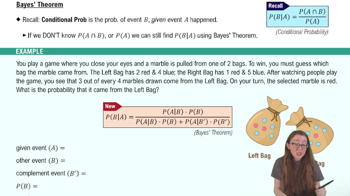
Bayes' Theorem
396
views
12
rank
Guided course
02:32
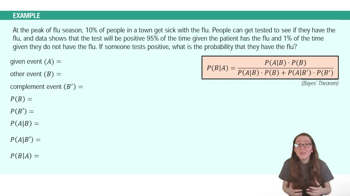
Bayes' Theorem Example 1
214
views
5
rank
Terms in this set (15)
Hide definitions
Conditional Probability
Likelihood of an event occurring when another event is already known to have happened.
Bayes' Theorem
A formula that updates the probability of an event based on new evidence or information.
Numerator
The top part of a probability fraction, often representing joint or combined probabilities.
Denominator
The bottom part of a probability fraction, typically representing the total or given probability.
Joint Probability
The chance that two events occur together, often used in the calculation of conditional probabilities.
Complement
The event representing all outcomes not included in a specific event, such as not drawing from a certain bag.
Event A
The known or given outcome in a probability scenario, such as drawing a red marble.
Event B
The outcome of interest in a probability scenario, such as selecting from a specific bag.
B Complement
The scenario where the outcome of interest does not occur, such as not selecting from the left bag.
Probability Fraction
A ratio expressing the likelihood of an event, with a numerator and denominator representing different probabilities.
Given Event
The condition or information already known when calculating conditional probabilities.
Prior Probability
The initial likelihood of an event before considering new evidence or information.
Posterior Probability
The updated likelihood of an event after incorporating new evidence using Bayes' theorem.
Sample Space
The set of all possible outcomes in a probability experiment, such as all marbles in both bags.
Fraction Simplification
The process of reducing probability ratios to their simplest form for easier interpretation.
 BackBack

 05:10
05:10