Skip to main content
Statistics for Business
My Course
Learn
Exam Prep
AI Tutor
Study Guides
Flashcards
Explore
Try the app
My Course
Learn
Exam Prep
AI Tutor
Study Guides
Flashcards
Explore
Try the app
Back
Binomial Distribution definitions
You can tap to flip the card.
Binomial Experiment
You can tap to flip the card.
👆
Binomial Experiment
A process with a fixed number of independent trials, each resulting in one of two possible outcomes.
Track progress
Control buttons has been changed to "navigation" mode.
1/16
Related flashcards
Related practice
Recommended videos
Binomial Distribution quiz
Binomial Distribution
15 Terms
Binomial Distribution
5. Binomial Distribution & Discrete Random Variables
10 problems
Topic
Ernest
5. Binomial Distribution & Discrete Random Variables
3 topics
15 problems
Chapter
Ernest
Guided course
02:58
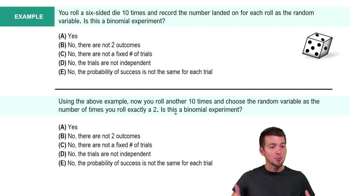
The Binomial Experiment Example 1
365
views
8
rank
Guided course
03:28
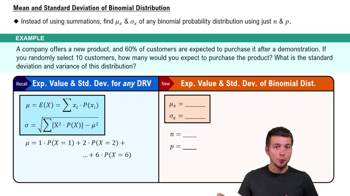
Mean & Standard Deviation of Binomial Distribution
388
views
3
rank
Guided course
03:33
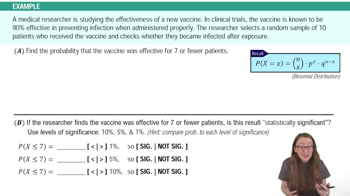
Finding Binomial Probabilities Using TI-84 Example 1
171
views
1
rank
Terms in this set (16)
Hide definitions
Binomial Experiment
A process with a fixed number of independent trials, each resulting in one of two possible outcomes.
Success
A desired outcome in a trial, such as getting heads in a coin flip or a red marble from a bag.
Failure
An outcome that is not the desired one, like tails in a coin flip or a blue marble from a bag.
Trial
A single repetition of an experiment, such as one coin flip or one marble draw.
Independence
A property where the outcome of one trial does not affect the outcome of another.
Probability of Success
The likelihood, denoted as p, that a single trial results in a desired outcome.
Probability of Failure
The likelihood, denoted as q, that a single trial does not result in a desired outcome; calculated as 1 minus p.
Number of Trials
The total count of times an experiment is repeated, represented by n.
Number of Successes
The count of times the desired outcome occurs in all trials, represented by x.
Expected Value
The average number of successes anticipated, found by multiplying the number of trials by the probability of success.
Standard Deviation
A measure of spread in the number of successes, calculated as the square root of n times p times q.
Variance
A measure of dispersion in the number of successes, equal to n times p times q.
Combination
A count of ways to arrange a specific number of successes among trials, often written as n choose x.
Complement
The set of outcomes not included in the event of interest, used to simplify probability calculations.
Binom PDF
A calculator function that finds the probability of exactly a certain number of successes in a binomial experiment.
Binom CDF
A calculator function that finds the probability of at most a certain number of successes in a binomial experiment.
 BackBack
 02:58
02:58