What are the four criteria that define a binomial experiment?
There must be only two possible outcomes per trial, a fixed number of independent trials, and the probability of success must remain constant for each trial.
In a binomial experiment, what does the variable 'n' represent?
'n' represents the total number of trials conducted in the experiment.
How do you calculate the probability of failure (q) in a binomial experiment?
The probability of failure, q, is calculated as 1 minus the probability of success, p (q = 1 - p).
What does the variable 'x' represent in binomial probability problems?
'x' represents the number of successes in the n trials of the experiment.
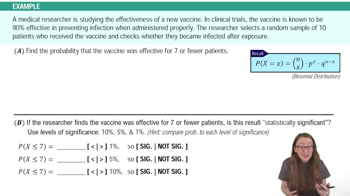
What is the formula for the probability of getting exactly x successes in n binomial trials?
The formula is P(X = x) = (n choose x) * p^x * q^(n-x), where (n choose x) is the combination of n items taken x at a time.
How do you calculate the expected value (mean) of a binomial distribution?
The expected value (mean) is calculated as μ = n × p.
What is the shortcut formula for the standard deviation of a binomial distribution?
The standard deviation is σ = √(n × p × q).
If a binomial experiment has n = 10 and p = 0.6, what is the expected number of successes?
The expected number of successes is 10 × 0.6 = 6.
Why must trials be independent in a binomial experiment?
Trials must be independent so that the outcome of one trial does not affect the outcome of another, ensuring constant probability of success.
How do you find the probability of a range of successes (e.g., between 0 and 2) in a binomial distribution?
You add the probabilities for each value in the range: P(X=0) + P(X=1) + P(X=2).
What is the complement rule in binomial probability calculations?
The complement rule states that P(X ≥ k) = 1 - P(X ≤ k-1), allowing you to find probabilities more efficiently.
Which calculator function is used to find the probability of exactly x successes in a binomial experiment?
The binomPDF function is used to find the probability of exactly x successes.
Which calculator function is used to find the probability of at most x successes in a binomial experiment?
The binomCDF function is used to find the probability of at most x successes (P(X ≤ x)).
How can you use binomCDF to find the probability of fewer than x successes?
You use binomCDF with x-1 as the value to find P(X < x), since binomCDF gives P(X ≤ x).
What is the relationship between variance and standard deviation in a binomial distribution?
Variance is the square of the standard deviation, so variance = σ² = n × p × q.
 Back
Back

 02:58
02:58