Skip to main content
Statistics for Business
My Course
Learn
Exam Prep
AI Tutor
Study Guides
Flashcards
Explore
Try the app
My Course
Learn
Exam Prep
AI Tutor
Study Guides
Flashcards
Explore
Try the app
Back
Chi Square Distribution quiz
You can tap to flip the card.
What type of distribution is used to construct confidence intervals for variance?
You can tap to flip the card.
👆
What type of distribution is used to construct confidence intervals for variance?
The chi-square distribution is used to construct confidence intervals for variance.
Track progress
Control buttons has been changed to "navigation" mode.
1/15
Related flashcards
Related practice
Recommended videos
Chi Square Distribution definitions
Chi Square Distribution
15 Terms
8. Sampling Distributions & Confidence Intervals: Proportion
2 topics
15 problems
Chapter
Laura
Guided course
05:18
Critical Values: Chi Square Distribution Example 2
75
views
Guided course
03:55
Critical Values: Chi Square Distribution Example 1
71
views
1
rank
Guided course
05:39
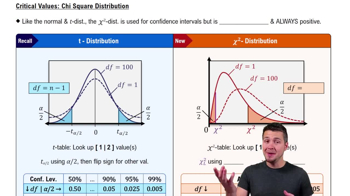
Critical Values: Chi Square Distribution
76
views
1
rank
Terms in this set (15)
Hide definitions
What type of distribution is used to construct confidence intervals for variance?
The chi-square distribution is used to construct confidence intervals for variance.
Why can't you use the same critical value for both tails in the chi-square distribution?
Because the chi-square distribution is asymmetric, you must find separate critical values for each tail.
What is the formula for degrees of freedom when using the chi-square distribution?
Degrees of freedom are calculated as n - 1, where n is the sample size.
What is the range of possible values for the chi-square distribution?
The chi-square distribution only takes positive values, starting at zero and extending to positive infinity.
How do you find the area to the right of the right-tail critical value in the chi-square table?
You use alpha/2 as the area to the right of the right-tail critical value.
How do you find the area to the right of the left-tail critical value in the chi-square table?
You use 1 - alpha/2 as the area to the right of the left-tail critical value.
What are the labels for the right and left critical values in the chi-square distribution?
The right critical value is labeled as chi-square r, and the left as chi-square l.
For a 95% confidence interval with n = 31, what are the degrees of freedom?
The degrees of freedom are 30, since 31 - 1 = 30.
What are the approximate critical values for a 95% confidence interval with n = 31?
The critical values are approximately 16.79 (left) and 46.98 (right).
How do you calculate alpha for a 95% confidence interval?
Alpha is calculated as 1 minus the confidence level, so alpha = 1 - 0.95 = 0.05.
What is the area used to find the right-tail critical value for a 95% confidence interval?
The area is alpha/2, which is 0.025 for a 95% confidence interval.
What is the area used to find the left-tail critical value for a 95% confidence interval?
The area is 1 - alpha/2, which is 0.975 for a 95% confidence interval.
Why can't you simply flip the sign of a chi-square critical value to find the other tail's value?
Because the chi-square distribution is not symmetric, flipping the sign does not give the correct value.
When using a chi-square table, what two pieces of information do you need to find a critical value?
You need the area to the right of the value and the degrees of freedom.
How are chi-square tables typically organized for finding critical values?
Chi-square tables have areas to the right across the top row and degrees of freedom down the side.
 BackBack

 05:18
05:18