What is the complement of an event in probability?
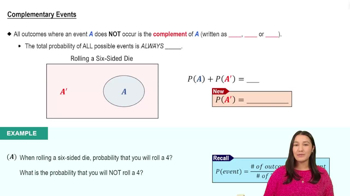
The complement of an event is all possible outcomes where the event does not occur.
How do you denote the complement of event A?
The complement of event A can be denoted as A' (A prime), a line over A, or ¬A.
What is the formula for the probability of the complement of event A?
The probability of the complement of A is P(¬A) = 1 - P(A).
If the probability of rolling a four on a six-sided die is 1/6, what is the probability of not rolling a four?
The probability of not rolling a four is 1 - 1/6 = 5/6.
How many outcomes are there for not rolling a four on a six-sided die?
There are five outcomes: rolling a one, two, three, five, or six.
What is the sum of the probability of an event and its complement?
The sum is always 1.
Why does the sum of an event and its complement equal one?
Because together, they cover all possible outcomes, representing 100% probability.
How many queens are in a standard deck of 52 cards?
There are four queens in a standard deck.
What is the probability of drawing a queen from a standard deck of cards?
The probability is 4/52.
How do you calculate the probability of not drawing a queen from a deck of cards?
Subtract the probability of drawing a queen from one: 1 - 4/52 = 48/52.
What is the decimal value of the probability of not drawing a queen from a deck?
The decimal value is 0.92.
Why is it easier to use the complement rule in some probability problems?
Because it can be simpler to calculate the probability of an event and subtract from one, rather than counting all outcomes where the event does not occur.
If P(A) = 0.3, what is P(¬A)?
P(¬A) = 1 - 0.3 = 0.7.
What does the complement rule help you find?
It helps you find the probability that an event does not happen.
In probability, what does 'covering 100% of the possibilities' mean?
It means that the event and its complement together account for all possible outcomes.
 Back
Back
 4:23
4:23