Skip to main content
Statistics for Business
My Course
Learn
Exam Prep
AI Tutor
Study Guides
Flashcards
Explore
Try the app
My Course
Learn
Exam Prep
AI Tutor
Study Guides
Flashcards
Explore
Try the app
Back
Confidence Intervals for Population Mean definitions
You can tap to flip the card.
Confidence Interval
You can tap to flip the card.
👆
Confidence Interval
A range of values, derived from sample data, that likely contains the true population mean with a specified confidence level.
Track progress
Control buttons has been changed to "navigation" mode.
1/15
Related flashcards
Related practice
Recommended videos
Confidence Intervals for Population Mean quiz
Confidence Intervals for Population Mean
15 Terms
Confidence Intervals for Population Mean
7. Sampling Distributions & Confidence Intervals: Mean
10 problems
Topic
Laura
7. Sampling Distributions & Confidence Intervals: Mean
3 topics
15 problems
Chapter
Ally
Guided course
04:30
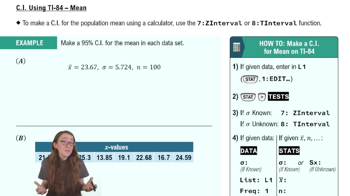
Finding Confidence Intervals Using TI-84
141
views
1
rank
04:06
Critical Values: t-Distribution Example 2
234
views
5
rank
Guided course
09:00
Population Standard Deviation Unknown Example 3
193
views
5
rank
Terms in this set (15)
Hide definitions
Confidence Interval
A range of values, derived from sample data, that likely contains the true population mean with a specified confidence level.
Population Mean
The average value of a variable for the entire group being studied, often represented by the Greek letter mu.
Sample Mean
The average value calculated from a subset of the population, used as a point estimate for the population mean.
Margin of Error
The amount added and subtracted from the sample mean to create the upper and lower bounds of a confidence interval.
Critical Z Value
A cutoff point from the standard normal distribution used when the population standard deviation is known.
Critical T Value
A cutoff point from the t distribution, used when the population standard deviation is unknown and estimated by the sample.
Population Standard Deviation
A measure of variability for the entire population, denoted by sigma, used in confidence interval calculations when known.
Sample Standard Deviation
A measure of variability within the sample, denoted by s, used to estimate the population standard deviation when unknown.
Degrees of Freedom
A parameter for the t distribution, calculated as the sample size minus one, affecting the shape of the distribution.
Normal Distribution
A symmetric, bell-shaped curve describing the spread of a variable, with mean zero and standard deviation one.
T Distribution
A probability distribution similar to the normal distribution but wider, used when estimating the mean with unknown population standard deviation.
Alpha
The probability of error in the tails of a confidence interval, calculated as one minus the confidence level.
Confidence Level
The probability that the confidence interval contains the true population mean, commonly expressed as a percentage.
Point Estimate
A single value, such as the sample mean, used to approximate an unknown population parameter.
Random Sample
A subset of the population selected so that every member has an equal chance of being chosen, ensuring unbiased results.
 BackBack

 04:30
04:30