Skip to main content
Statistics for Business
My Course
Learn
Exam Prep
AI Tutor
Study Guides
Flashcards
Explore
Try the app
My Course
Learn
Exam Prep
AI Tutor
Study Guides
Flashcards
Explore
Try the app
Back
Confidence Intervals for Population Proportion quiz
You can tap to flip the card.
What is the first step before constructing a confidence interval for a population proportion?
You can tap to flip the card.
👆
What is the first step before constructing a confidence interval for a population proportion?
Verify that both the number of successes and failures are at least five.
Track progress
Control buttons has been changed to "navigation" mode.
1/15
Related flashcards
Related practice
Recommended videos
Confidence Intervals for Population Proportion definitions
Confidence Intervals for Population Proportion
15 Terms
Confidence Intervals for Population Proportion
8. Sampling Distributions & Confidence Intervals: Proportion
10 problems
Topic
Ernest
8. Sampling Distributions & Confidence Intervals: Proportion
2 topics
15 problems
Chapter
Laura
Guided course
02:35
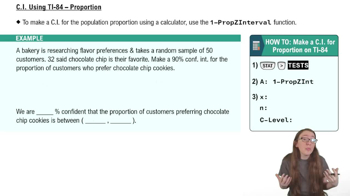
Finding a Confidence Interval for a Population Proportion Using a TI84
125
views
04:24
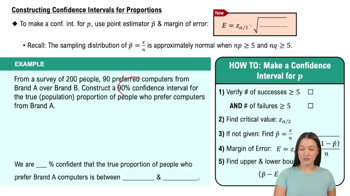
Constructing Confidence Intervals for Proportions Example 2
154
views
2
rank
05:45
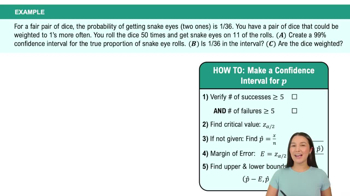
Constructing Confidence Intervals for Proportions
322
views
3
rank
Terms in this set (15)
Hide definitions
What is the first step before constructing a confidence interval for a population proportion?
Verify that both the number of successes and failures are at least five.
How do you calculate the point estimate (p̂) for a population proportion?
Divide the number of successes (x) by the total sample size (n).
What is the formula for the margin of error (e) when constructing a confidence interval for a proportion?
e = zα/2 × sqrt[p̂(1-p̂)/n]
How do you find the critical z value for a given confidence level?
Subtract the confidence level from 1, divide by 2, and use a z-table or calculator to find the corresponding z value.
What does a 90% confidence interval mean in the context of population proportion?
It means we are 90% confident that the true population proportion lies within the calculated interval.
If you are not given p̂ when calculating minimum sample size, what value should you use and why?
Use p̂ = 0.5 because it gives the largest required sample size for a given margin of error.
How do you calculate the lower and upper bounds of a confidence interval for a proportion?
Subtract the margin of error from p̂ for the lower bound and add it to p̂ for the upper bound.
What is the formula to calculate the minimum sample size (n) for a desired margin of error?
n = [zα/2 / e]^2 × p̂(1-p̂)
Why do you round up the sample size when calculating the minimum required n?
Because you cannot sample a fraction of a subject, so you need a whole number.
What function on the TI-84 calculator is used to construct a confidence interval for a population proportion?
Use the '1-PropZInt' or '1-Prop C Interval' function.
What information do you need to enter into the TI-84 to calculate a confidence interval for a proportion?
You need the number of successes (x), sample size (n), and the confidence level.
If a sample of 50 customers includes 32 who prefer chocolate chip, what is p̂?
p̂ = 32/50 = 0.64
What does it mean if your confidence interval for a proportion is (0.528, 0.752)?
You are confident at the specified level (e.g., 90%) that the true population proportion is between 0.528 and 0.752.
Why is it important to check that both np and nq are at least 5 before constructing a confidence interval?
This ensures the sampling distribution of p̂ is approximately normal, which is required for the interval to be valid.
How does increasing the sample size affect the margin of error in a confidence interval for a proportion?
Increasing the sample size decreases the margin of error, making the confidence interval narrower.
 BackBack

 02:35
02:35