Skip to main content
Statistics for Business
My Course
Learn
Exam Prep
AI Tutor
Study Guides
Flashcards
Explore
Try the app
My Course
Learn
Exam Prep
AI Tutor
Study Guides
Flashcards
Explore
Try the app
Back
Counting definitions
You can tap to flip the card.
Permutation
You can tap to flip the card.
👆
Permutation
Arrangement of distinct objects where order is important and each object is used only once.
Track progress
Control buttons has been changed to "navigation" mode.
1/15
Related flashcards
Related practice
Recommended videos
Counting quiz
Counting
15 Terms
Counting
4. Probability
10 problems
Topic
Ernest
Fundamental Counting Principle
4. Probability
10 problems
Topic
Ernest
4. Probability
9 topics
15 problems
Chapter
Ernest
03:59
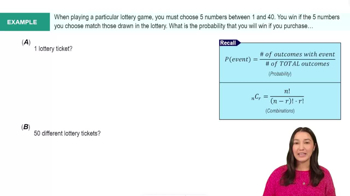
Counting Example 1
188
views
4
rank
03:18
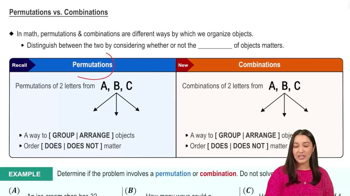
Permutations vs. Combinations
254
views
6
rank
07:11
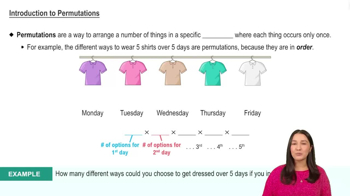
Introduction to Permutations
347
views
8
rank
Terms in this set (15)
Hide definitions
Permutation
Arrangement of distinct objects where order is important and each object is used only once.
Combination
Grouping of objects where order is irrelevant; only the selection of items matters.
Factorial
Product of all positive integers up to a given number, denoted by an exclamation mark.
Fundamental Counting Principle
Rule stating that the total number of outcomes is the product of the number of choices at each step.
Distinct Objects
Items that are all different from each other, making their arrangement unique.
Non-distinct Objects
Items that are identical, requiring special consideration in counting arrangements.
Permutation Formula
Expression n!/(n−r)! used to calculate arrangements where order matters.
Combination Formula
Expression n!/[r!(n−r)!] used to count groupings where order does not matter.
Notation
Symbols such as P(n, r) or C(n, r) representing permutations or combinations.
Numerator
Top part of a fraction, often representing the total number of arrangements in counting formulas.
Denominator
Bottom part of a fraction, often used to adjust for repeated or unordered selections.
Outcome
A possible result from arranging or selecting objects in a counting problem.
Order
Sequence in which objects are arranged or selected, crucial in distinguishing permutations from combinations.
Selection
Process of choosing objects from a set, regardless of arrangement.
Grouping
Collection of objects considered together, especially when order is not important.
 BackBack
 03:59
03:59