Skip to main content
Statistics for Business
My Course
Learn
Exam Prep
AI Tutor
Study Guides
Flashcards
Explore
Try the app
My Course
Learn
Exam Prep
AI Tutor
Study Guides
Flashcards
Explore
Try the app
Back
Counting quiz
You can tap to flip the card.
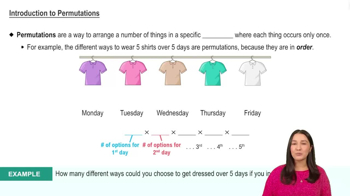
What is a permutation in the context of counting?
You can tap to flip the card.
👆
What is a permutation in the context of counting?
A permutation is an arrangement of distinct objects where the order matters and each object is used only once.
Track progress
Control buttons has been changed to "navigation" mode.
1/15
Related flashcards
Related practice
Recommended videos
Counting definitions
Counting
15 Terms
Counting
4. Probability
10 problems
Topic
Ernest
Fundamental Counting Principle
4. Probability
10 problems
Topic
Ernest
4. Probability
9 topics
15 problems
Chapter
Ernest
03:59
Counting Example 1
188
views
4
rank
03:18
Permutations vs. Combinations
254
views
6
rank
07:11
Introduction to Permutations
347
views
8
rank
Terms in this set (15)
Hide definitions
What is a permutation in the context of counting?
A permutation is an arrangement of distinct objects where the order matters and each object is used only once.
How do you calculate the number of permutations of n objects taken r at a time?
The number of permutations is calculated using the formula n! / (n - r)!, where n is the total number of objects and r is the number chosen.
In permutations, what does the '!' symbol represent?
The '!' symbol represents a factorial, which is the product of all positive integers up to that number.
How does the fundamental counting principle relate to permutations?
The fundamental counting principle helps determine the number of ways to arrange objects by multiplying the number of choices for each position.
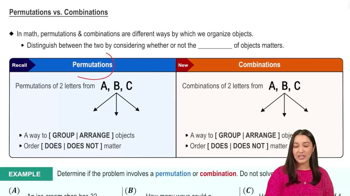
What is the difference between permutations and combinations?
Permutations consider the order of objects, while combinations do not; in combinations, the arrangement is irrelevant.
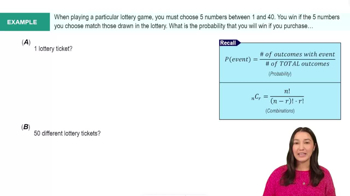
How do you calculate the number of combinations of n objects taken r at a time?
The number of combinations is calculated using the formula n! / [r! (n - r)!], where n is the total and r is the number chosen.
When arranging objects with some identical items, how is the permutation formula adjusted?
For non-distinct objects, the formula is n! divided by the factorials of the counts of each type of identical object.
How many different eight-digit codes can be made from five zeros and three ones?
There are 56 different eight-digit codes, calculated as 8! / (5! × 3!).
How do you determine if a problem is a permutation or a combination?
Ask if the order of selection matters; if yes, it's a permutation, if no, it's a combination.
What is the formula for the number of ways to arrange the letters in the word 'banana'?
The formula is 6! / (1! × 3! × 2!), accounting for the repeated letters.
If an ice cream shop has 32 flavors and you pick 2 to blend, is this a permutation or combination and why?
It's a combination because the order of the flavors does not matter in the blend.
How many ways can a teacher choose a line leader and a door holder from 25 students?
There are 600 ways, calculated as 25 × 24, since order matters (permutation).
What is the notation for permutations and combinations?
Permutations are denoted as P(n, r) or nPr, and combinations as C(n, r) or nCr.
Why do you divide by r! in the combinations formula?
You divide by r! to account for the fact that the order of the selected r objects does not matter.
How many different teams of 4 can be formed from 9 people?
There are 126 different teams, calculated as 9! / (5! × 4!).
 BackBack
 03:59
03:59