Skip to main content
Statistics for Business
My Course
Learn
Exam Prep
AI Tutor
Study Guides
Flashcards
Explore
Try the app
My Course
Learn
Exam Prep
AI Tutor
Study Guides
Flashcards
Explore
Try the app
Back
Critical Values and Rejection Regions definitions
You can tap to flip the card.
Critical Value
You can tap to flip the card.
👆
Critical Value
A threshold from the alpha level that separates expected test statistics from those considered statistically unusual.
Track progress
Control buttons has been changed to "navigation" mode.
1/15
Related flashcards
Related practice
Recommended videos
Critical Values and Rejection Regions quiz
Critical Values and Rejection Regions
15 Terms
9. Hypothesis Testing for One Sample
3 topics
15 problems
Chapter
Brendan
Guided course
06:25
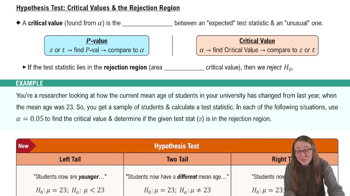
Critical Values and Rejection Regions
92
views
Guided course
03:35
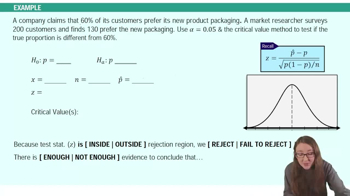
Performing Hypothesis Test with Critical Values Example 1
66
views
Guided course
05:37
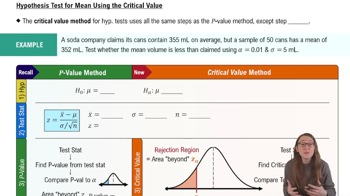
Performing Hypothesis Test with Critical Values
67
views
Terms in this set (15)
Hide definitions
Critical Value
A threshold from the alpha level that separates expected test statistics from those considered statistically unusual.
Rejection Region
The area beyond the critical value(s) where test statistics provide strong evidence against the null hypothesis.
Alpha Level
The probability threshold, often 0.05 or 0.01, used to determine the size of the rejection region in hypothesis testing.
Test Statistic
A calculated value, such as z or t, that summarizes sample data for comparison against a critical value.
Null Hypothesis
A default assumption about a population parameter, typically stating no effect or no difference.
Alternative Hypothesis
A statement indicating the presence of an effect or difference, opposing the null hypothesis.
Left-Tailed Test
A hypothesis test where the rejection region is in the lower tail of the distribution, indicating values less than expected.
Right-Tailed Test
A hypothesis test where the rejection region is in the upper tail, indicating values greater than expected.
Two-Tailed Test
A hypothesis test with rejection regions in both tails, used when deviations in either direction are significant.
Z Table
A reference chart providing probabilities or critical values for the standard normal distribution.
P Value
The probability of observing a test statistic as extreme as, or more extreme than, the one calculated, assuming the null hypothesis is true.
Sample Size
The number of observations or data points included in a statistical sample.
Population Standard Deviation
A measure of variability in the entire population, often denoted by sigma (σ), used in test statistic calculations.
Test Criteria
The conditions that must be met for the results of a hypothesis test to be valid, such as normality or sufficient sample size.
Significance Level
Another term for alpha level, representing the probability of making a Type I error in hypothesis testing.
 BackBack
 06:25
06:25